
Your high school GPA is one number that sums up how you've done across all your classes. Colleges look at it, scholarship committees look at it, and your parents probably ask about it. The good news is that the math is plain arithmetic, and you only need your grades and each course's credit value.
This guide on how to calculate high school GPA shows you how to work out one semester, how to build it up across all four years, and where honors and AP classes change the result.
Have your grades and credits handy?
Drop them into the High School GPA Calculator and compare the result with the number you just worked out by hand.
Calculate my GPA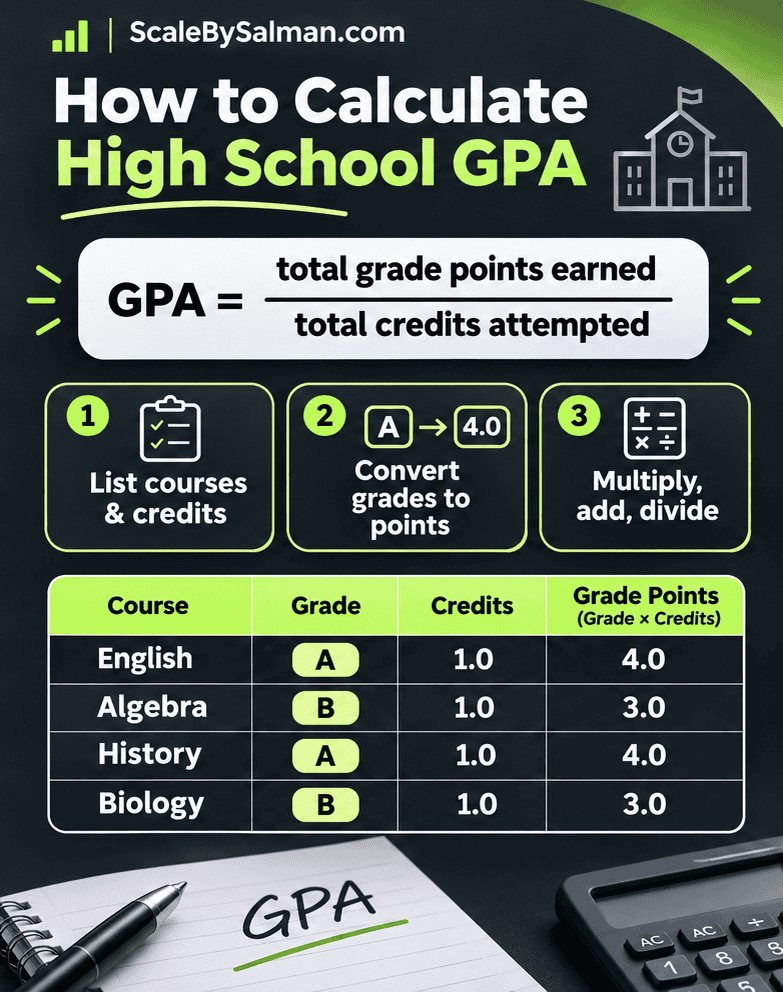
The formula and three steps for a high school GPA.
GPA stands for grade point average. Each letter grade turns into points, usually on a 4.0 scale. Then you average those points, giving more weight to courses that count for more credit.
The formula is: GPA = total grade points earned ÷ total credits attempted, where "grade points earned" means each course's points multiplied by its credits. Those products are often called quality points, so you'll also see GPA written as total quality points divided by total credits.
Grab your latest report card or transcript. For each class, write down the final letter grade and its credit value. A full-year course is often 1.0 credit, and a half-year course is often 0.5, but check your school's system.
Use your school's scale if it publishes one. Many schools use this one:
Here's a sample semester for a sophomore:
That's your unweighted GPA for the semester. Try it with your own numbers in the High School GPA Calculator, which also lets you edit the grade points to match your school.
Weighted GPA gives extra points for harder courses. A common pattern is +0.5 for honors and +1.0 for AP or IB, but schools set their own rules, and some use no weighting at all.
Use the same sophomore, and say Biology was Honors (+0.5) and nothing else changed. The weighted points for Biology become 3.5, so the total becomes 19.2 and the weighted GPA is 19.2 ÷ 5.5 = 3.49. The unweighted GPA stays 3.40.
If you're curious about which one matters when, weighted vs unweighted GPA explains it. And if you need the unweighted version specifically, see how to calculate unweighted GPA.
Cumulative GPA covers everything from freshman year to now. You don't average your semester GPAs, because semesters can carry different credit loads. Instead, add up all the points and credits from every term.
Say your freshman year had 28.0 total points over 7.0 credits, and your sophomore semester above has 18.7 points over 5.5 credits. Together that's 46.7 points over 12.5 credits, so:
46.7 ÷ 12.5 = 3.74
Averaging the two semester GPAs (4.00 and 3.40) would give 3.70, which isn't quite the same. That's why the totals-over-totals method is the right one. Our guide to calculating cumulative GPA goes deeper on this.
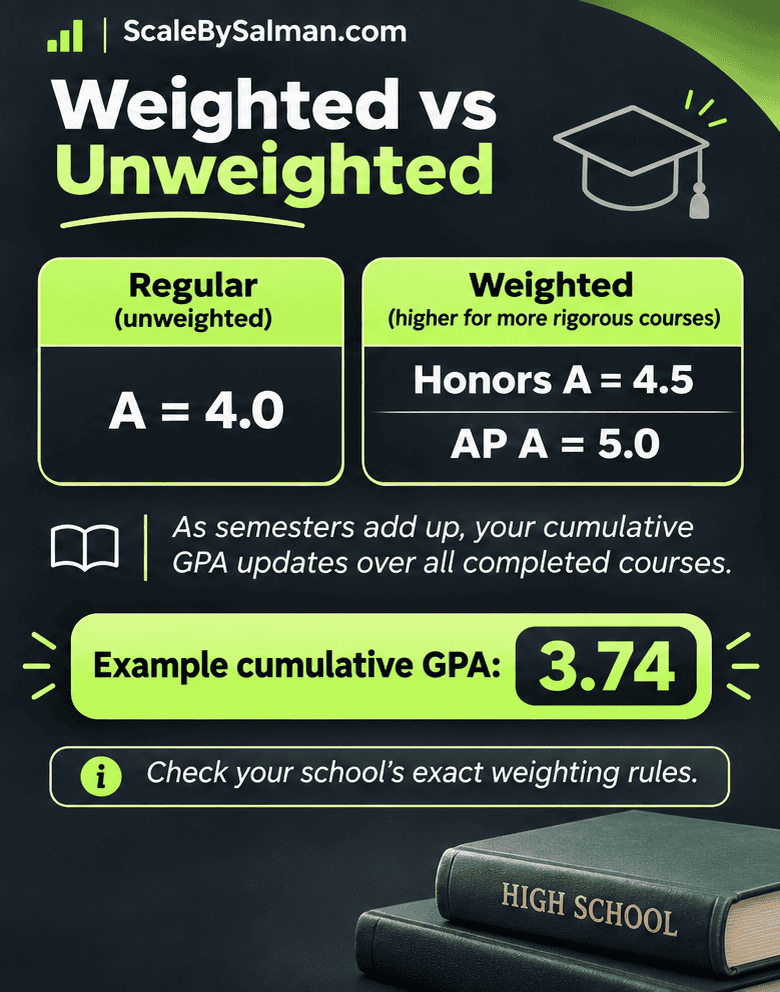
Weighted vs unweighted at a glance, plus the 3.74 cumulative GPA from the worked example.
Some schools report 0 to 100 averages instead of letters. In that case you need a conversion step before the usual math. Ask your counselor for the school's percentage-to-grade-point table, because there's no single national one. A common approach is to turn the percentage into a letter first, for instance 90 to 92 as an A−, then to points. Once every course is in points, the process above is identical.
If your school doesn't publish a table, you can still estimate by using the standard plus/minus scale. Just remember it's an estimate, and your transcript decides what's official.
Seeing the numbers stack up helps. Here's a student's record, with each row showing totals so far:
Each new term adds to the totals, and the cumulative GPA is always total points divided by total credits. A weaker term pulls the number down a little, and a stronger term lifts it. The more credits you've already banked, the less any single term moves it, which is why early grades matter and why late improvements still count.
Not every course gets counted the same way. Common differences:
Your counselor knows your school's policy. Calculate it yourself to plan, and use the transcript for official purposes.
Once you can calculate GPA, you can run "what if" numbers. If you've earned 46.7 points over 12.5 credits and plan to take 6.0 credits next semester, a straight run of As (4.0 each) would add 24.0 points. That gives 70.7 ÷ 18.5 = 3.82. A run of Bs (3.0) would give 64.7 ÷ 18.5 = 3.50. Seeing both helps you decide where to put effort.
A few more reads once you've got your number:
Convert each final letter grade to grade points, multiply by the course's credits, add everything up, and divide by total credits. For example, 18.7 points over 5.5 credits is a 3.40 GPA.
Add your school's bonus to the grade points for those courses (commonly +0.5 for honors and +1.0 for AP or IB), then use the same total points divided by total credits formula. Your school's weighting rules decide the exact bonus.
Add up the grade points and credits from every semester, then divide total points by total credits. Don't average the semester GPAs, because semesters can have different numbers of credits.
Convert each percentage to a letter grade using your school's scale, then to grade points. If your school doesn't publish a conversion, ask your counselor which scale applies.
It depends on the college. Some use your school's weighted GPA, some recalculate their own, and many look at the transcript and course rigor too. Check each college's admissions page.
Run through this short list before you put a number on an application or form:
Knowing how to calculate high school GPA comes down to three things: grade points, credits and a clean division. Start with one semester, then add terms for your cumulative number. When you want it done quickly, the High School GPA Calculator will run it for you in seconds.
ScaleBySalman has free calculators for GPA, grades and final exams, and none of them needs an account. Start from the ScaleBySalman homepage, browse the full free tools directory, or read more in the guides library. Questions about your data or our rules? Read the privacy policy and the terms of use, and see our advertising disclosure.
Browse all tools