
There is no single number that is a good GPA for everyone. What counts as good depends on where you study, what you are aiming for and which scale your school uses. This guide explains what a GPA number means, what changes its meaning and how to find the number that matters for your goal. To check your own number first, use the College GPA Calculator or the High School GPA Calculator.
On the standard 4.0 scale a 4.0 means straight A grades, a 3.0 is a B average and a 2.0 is a C average. A 3.5 sits halfway between a B (3.0) and an A (4.0), and it is 87.5% of the 4.0 maximum (3.5 ÷ 4.0 = 0.875). On a plus and minus scale a 3.7 is an A- average and a 3.3 is a B+ average. Not every school uses these values, and a weighted GPA can be higher than 4.0, so compare numbers only when they use the same scale.
How far a term moves your cumulative GPA depends on how many credits you already have. Suppose you earn a 4.0 over 15 credits, which is 60 quality points.
With 30 credits at 3.2 (96 quality points): (96 + 60) ÷ (30 + 15) = 156 ÷ 45 = 3.47
With 90 credits at 3.2 (288 quality points): (288 + 60) ÷ (90 + 15) = 348 ÷ 105 = 3.31
The same strong term lifts the short record by 0.27 and the long record by 0.11.
Work out the target with the formula:
Needed GPA = (Target × total credits after the term − current quality points) ÷ new credits
With 45 credits at 3.2 (144 quality points) and 15 new credits, a 3.4 target needs (3.4 × 60 − 144) ÷ 15 = 60 ÷ 15 = 4.0 in one term. A 3.5 target needs 4.4, which is not possible on a 4.0 scale, so it takes more than one term.
Credits matter: improving a grade in a high-credit course moves the average more than the same change in a low-credit course. Ask your registrar whether a repeated course replaces the earlier grade or is averaged with it. The method is in How to Calculate Cumulative GPA in College.
High schools often report an unweighted GPA, a weighted GPA or both, and weighted values can pass 4.0. Colleges calculate a cumulative GPA by credits. When a requirement does not say which it means, ask. See Weighted vs Unweighted GPA and How to Calculate GPA. The method for school grades is in how to calculate high school GPA.
To test a plan, enter your current courses and a planned term in the College GPA Calculator.
A 3.0 is a B average on the standard 4.0 scale. Whether it is good depends on the requirement you are aiming for, so check that minimum.
A 3.5 falls between a B+ (3.3) and an A- (3.7) on a plus and minus scale, and it is 87.5% of the 4.0 maximum. It is a strong result on most scales, but the answer still depends on the minimum set by your scholarship, program or employer.
On an unweighted 4.0 scale it means straight A grades. Weighted scales can go higher.
Both use grade points, but colleges calculate a cumulative GPA by credits and high schools often report weighted and unweighted numbers. Compare only like with like.
Each college sets its own expectations. Read its admissions page. Many also consider the courses you took, not only the number.
It can, but each program, award or employer decides. Many state a minimum or preferred GPA in the application terms or the job posting, and some do not ask for it. Read the requirement itself and note whether it means cumulative or major GPA.
Yes, but how fast depends on your credits. A term moves a short record more than a long one. Use the target formula above, or the cumulative GPA guide.
Total quality points divided by total credits. See How to Calculate GPA.
Calculators: College GPA Calculator and High School GPA Calculator. Rules: Methodology.
Free calculators
Pick the next tool for what you're working out. Each one shows its formula and assumptions, and none needs an account.
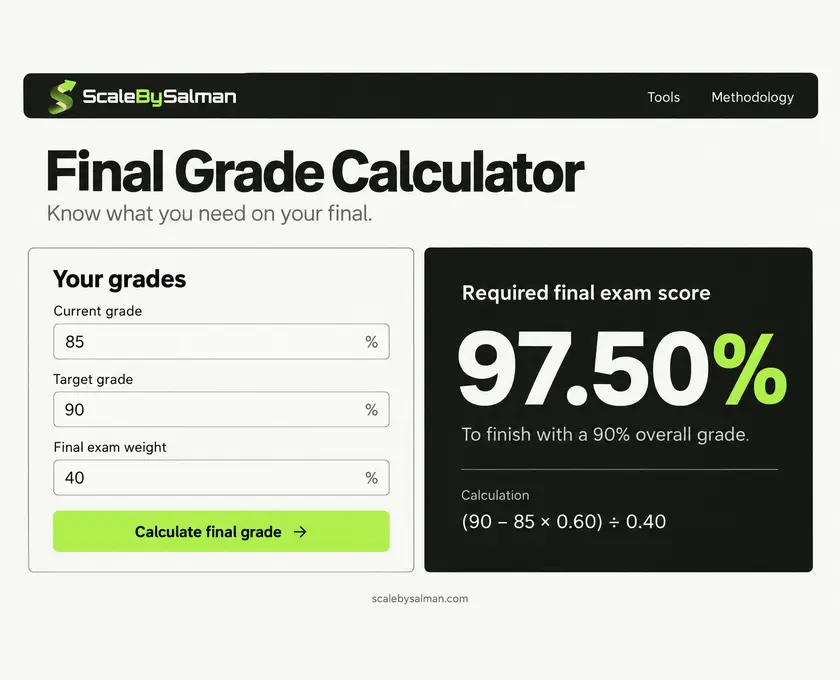
Find the exam score you need to reach your target course grade.
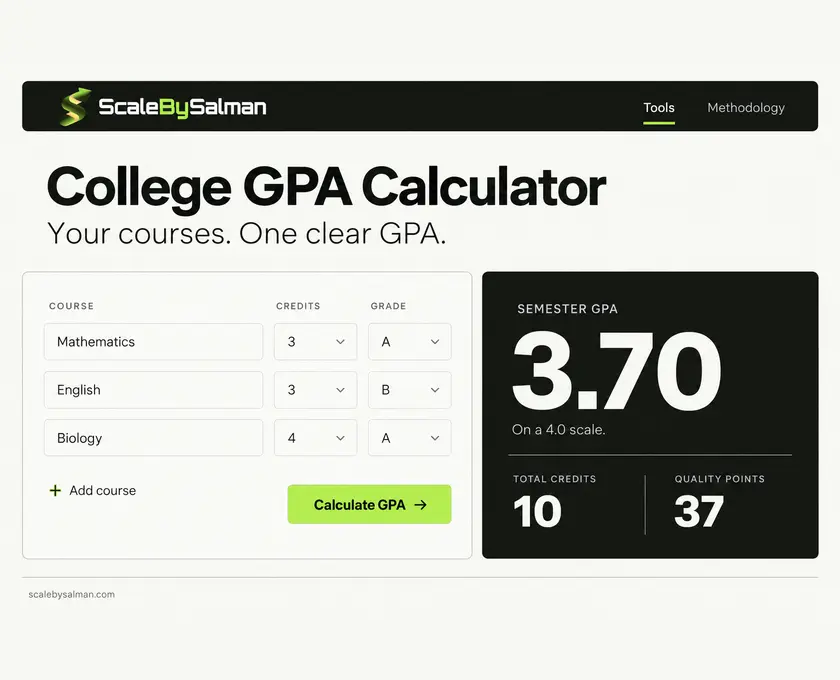
Calculate semester and cumulative GPA from course grades and credit hours.
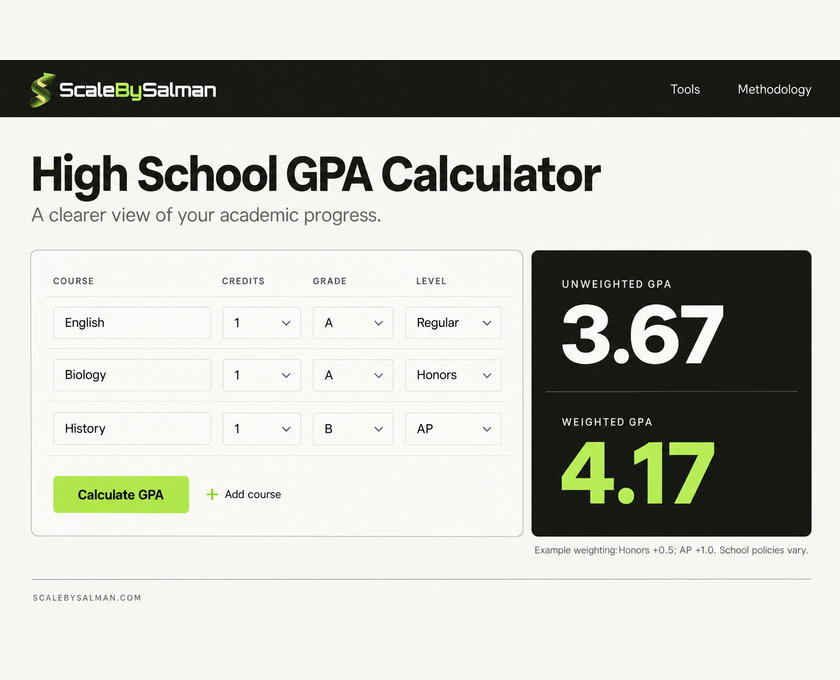
Weighted and unweighted GPA from course grades, levels and credits.
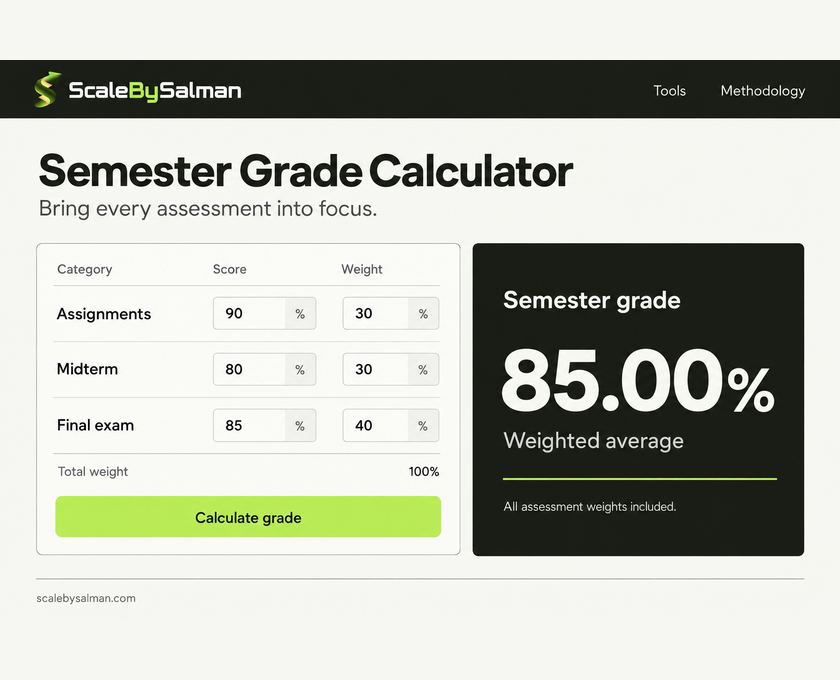
Combine quarter grades and exam weights into one semester result.
Looking for something else? See all the free tools, read more in the guides library, or go back to the ScaleBySalman homepage. Questions about your data or our rules? Read the privacy policy and the terms of use, and see our advertising disclosure.