
Your GPA (grade point average) is the average of your course grades after each letter grade is turned into grade points and weighted by credits. The formula is short, and the same method works for high school and college. This guide walks through it step by step with worked examples. To skip the arithmetic, use the College GPA Calculator or the High School GPA Calculator. If you only need the number and not the method, see how to find your GPA.
GPA = total quality points ÷ total GPA credits
Quality points for a course = grade points × credits.
If every course has the same number of credits, GPA is simply the average of the grade points.
Grades A, B, A, C and B give grade points 4.0, 3.0, 4.0, 2.0 and 3.0.
GPA = (4.0 + 3.0 + 4.0 + 2.0 + 3.0) ÷ 5 = 16 ÷ 5 = 3.20
Biology, 4 credits, grade A: 4.0 × 4 = 16.0 quality points
English, 3 credits, grade B: 3.0 × 3 = 9.0 quality points
Statistics, 3 credits, grade A-: 3.7 × 3 = 11.1 quality points
PE, 1 credit, grade A: 4.0 × 1 = 4.0 quality points
Total: 40.1 quality points over 11 credits
GPA = 40.1 ÷ 11 = 3.65
A percentage is not a grade point until your school says how it converts. Look up your school’s table, convert each percentage to a letter grade and then to grade points, and use the normal formula. For example, if your school maps 90 to 100 to an A (4.0) and 80 to 89 to a B (3.0), a 92 in a 3-credit course and an 85 in a 4-credit course give (4.0 × 3 + 3.0 × 4) ÷ 7 = 24 ÷ 7 = 3.43. Another school’s table can give a different answer, so check yours. The High School GPA Calculator has a percentage mode.
An unweighted GPA uses the table above. A weighted GPA adds extra points for honors, AP or IB courses, so it can go above 4.0. The weights are set by each school. See Weighted vs Unweighted GPA for worked examples, or enter your courses in the High School GPA Calculator to see both numbers. For a worked unweighted example, and why a weighted GPA cannot simply be converted back, see how to calculate unweighted GPA.
Cumulative GPA combines all your terms by credits. It is not the average of your semester GPAs. Suppose you have 30 credits at a 3.2 GPA (96 quality points) and then earn the 40.1 quality points over 11 credits from Example 2.
Cumulative GPA = (96 + 40.1) ÷ (30 + 11) = 136.1 ÷ 41 = 3.32
The full method is in How to Calculate Cumulative GPA in College. The same idea applies in school; how to calculate high school GPA shows it with credits and honors or AP weighting.
A course grade is the percentage or letter you earn in one class, worked out from assignments and exams. GPA averages the grade points of many courses. To work out a course grade, read How to Calculate Your Final Grade and use the Semester Grade Calculator. To find the exam score you need, use the Final Grade Calculator.
Schools treat these differently. Many exclude pass/fail courses and withdrawals from GPA, some replace a repeated grade, and transfer credits may or may not count. A calculator only knows what you enter, so check your registrar's rules and enter only the credits that count toward GPA.
Recalculate after final grades post each term, because a tracker you keep yourself can drift from the transcript. Recalculate before a withdrawal or add/drop deadline, so you can see what dropping or retaking a course would do. Recalculate before you apply for anything with a minimum GPA, using the grade-point table and the repeat rule your school publishes.
Use the College GPA Calculator for credit-weighted college courses, the High School GPA Calculator to see weighted and unweighted GPA side by side, the Semester Grade Calculator to work out a course grade from its graded parts, and the Final Grade Calculator to find the exam score you need.
GPA = total quality points ÷ total GPA credits, where quality points are grade points × credits for each course.
It depends on your goal and your school. See What Is a Good GPA?
On the standard 4.0 scale a 3.0 is a B average. Your school's table is the one that counts.
Multiply each course's grade points by its credits, add the results, and divide by the total credits. In Example 2 above, 40.1 quality points over 11 credits gives 3.65.
Find the nearest value on your school's grade-point table. On the standard table, 3.65 sits between B+ (3.3) and A- (3.7), just under A-.
Yes, on weighted scales that give extra points for advanced courses.
Keep extra decimals until the final division, then round the way your school does, often to two or three decimals.
Only if they have the same credits. Otherwise credits weight the average.
Calculators: College GPA Calculator and High School GPA Calculator. Rules: Methodology.
Free calculators
Pick the next tool for what you're working out. Each one shows its formula and assumptions, and none needs an account.
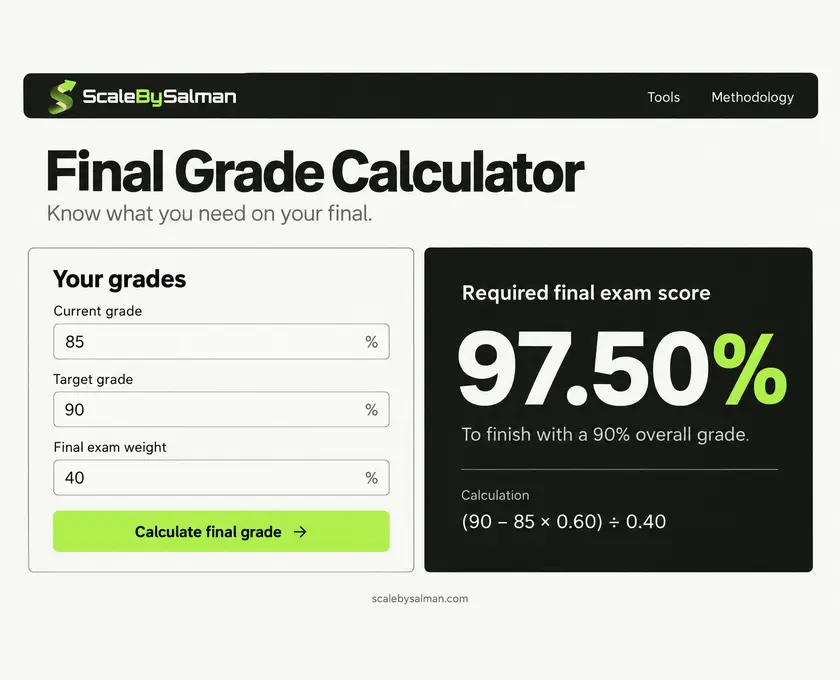
Find the exam score you need to reach your target course grade.
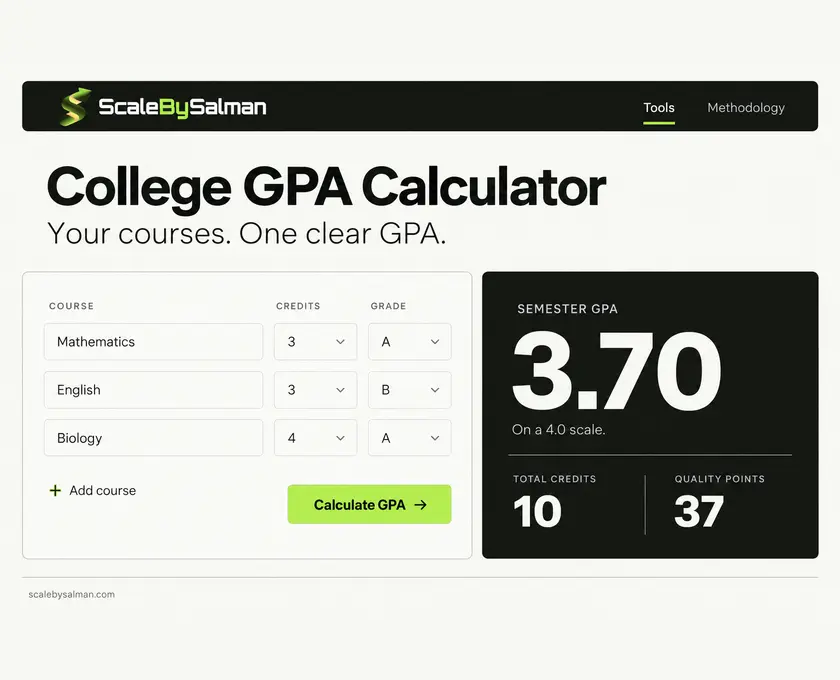
Calculate semester and cumulative GPA from course grades and credit hours.
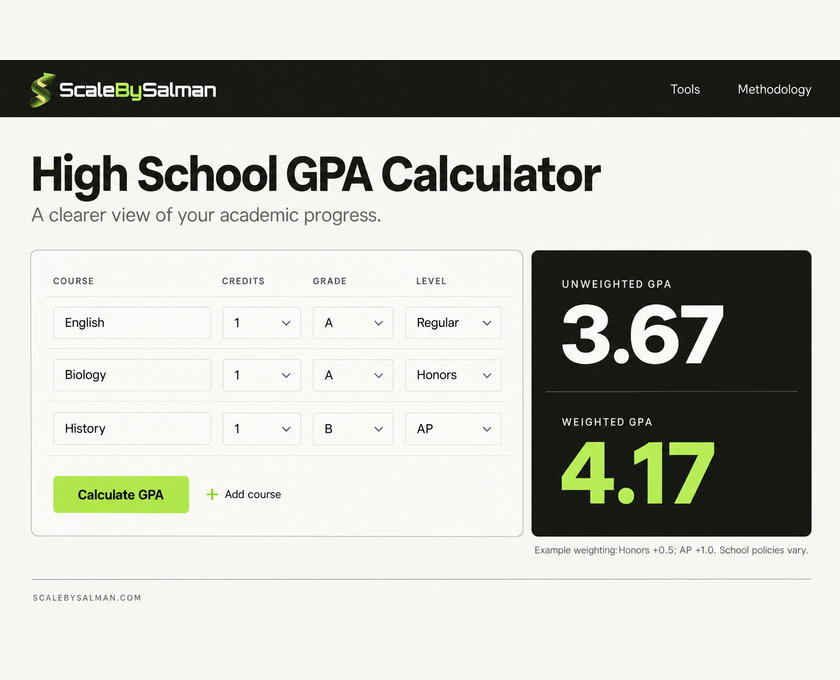
Weighted and unweighted GPA from course grades, levels and credits.
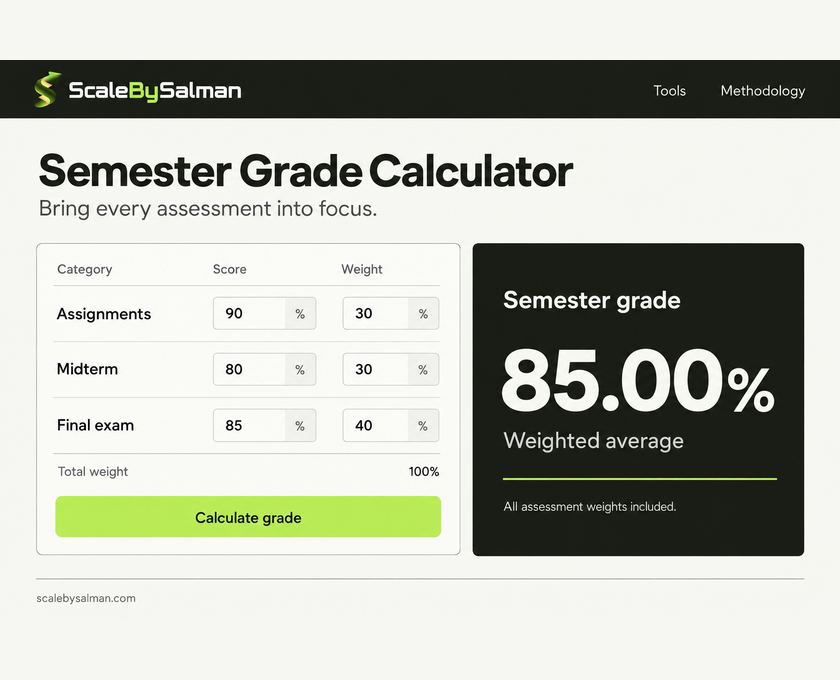
Combine quarter grades and exam weights into one semester result.
Looking for something else? See all the free tools, read more in the guides library, or go back to the ScaleBySalman homepage. Questions about your data or our rules? Read the privacy policy and the terms of use, and see our advertising disclosure.