
How to Calculate Your Test Grade and Test Score Percentage
If every question is worth the same and there’s no partial credit, divide your correct answers by the total number of questions that count toward your grade. Multiply by 100 to get your test percentage.
Test percentage = (Correct answers ÷ Total questions) × 100
A step-by-step guide that covers partial credit and wrong answers is in how to calculate test percentage.
The Test Grade Percentage Formula
The first two methods apply when every question is worth the same and there is no partial credit. In the second, “Wrong” includes skipped questions if your teacher counts them as incorrect.
1. Correct answers and total questions: (Correct ÷ Total) × 100 = percentage score
2. Wrong answers and total questions: ((Total − Wrong) ÷ Total) × 100 = percentage score
3. Points earned and points possible: (Earned ÷ Possible) × 100 = percentage score
Use the same total your teacher uses. Include skipped questions if they count as incorrect. If your teacher removed a question from scoring, use the adjusted total. If questions carry different point values or you earned partial credit, use Points and divide points earned by points possible, then multiply by 100.
Step-by-Step: How to Calculate a Test Score
Here's how to work it out manually if you want to double-check the calculator:
Count your correct answers. If the teacher marked 6 wrong out of 30, subtract: 30 − 6 = 24 correct.
Divide by the total number of questions. 24 ÷ 30 = 0.8.
Multiply by 100. (0.8 × 100 = 80%)
Round if needed. Your score is 80%, which is a B− on the plus/minus scale in the chart below, or a flat B on the simplified 10-point scale (no plus/minus).
How to Calculate Correct Answers From a Percentage
You can work backward from an exact percentage if every question is worth the same and the score has no partial credit, bonus points, or penalties.
Correct answers = (Percentage × Total questions) ÷ 100
For example, 82% of 200 questions is 164 correct answers: 82 × 200 ÷ 100 = 164. The other 36 did not earn credit. To check it, enter 200 total questions and 164 correct answers in the calculator above.
If your calculation gives a fraction of a question, the percentage may have been rounded or the test may use different scoring rules. For example, 27 out of 33 is about 81.82%, which rounds to 82% to the nearest whole percent. A rounded percentage can sometimes match more than one possible score.
Points to Percentage: Turn Any Test Score Into a Grade
Points and marks work the same way: divide what you earned by what was possible, then multiply by 100. For 68 marks out of 80: 68 ÷ 80 × 100 = 85%. In Points mode, enter 68 as points earned and 80 as points possible. Letter grades below use the plus/minus scale.
- 32 out of 40 = 80% (B−)
- 45 out of 60 = 75% (C)
- 27 out of 30 = 90% (A−)
- 17 out of 25 = 68% (D+)
- 68 out of 80 = 85% (B)
- 42.5 out of 50 = 85% (B)
For more common scores, see the test score to letter grade chart.
Test Score Examples
66% from 132 out of 200. Divide 132 by 200, then multiply by 100: 132 ÷ 200 × 100 = 66%. On the plus/minus scale below, 66% is a D.
32 out of 40 is 80%. 32 ÷ 40 × 100 = 80%. If every question has the same value, you answered 32 correctly and missed 8. That is a B− on the plus/minus scale.
A test where each question has a fixed point value. Say a test is worth 80 points and every question is worth 5 points, so there are 16 questions. Each missed question earns zero points in this example. If you miss 7 questions, you lose 7 × 5 = 35 points. Your score is 80 − 35 = 45 points, which is 45 ÷ 80 × 100 = 56.25%, an F on both scales on this page. If you miss x questions (from 0 to 16), your score is 80 − 5x points.
How Many Questions Can You Get Wrong and Still Pass?
If all questions carry equal marks and there’s no partial credit or penalty, multiply the total number of questions by the passing percentage and divide by 100. Round up to the next whole number when the result has a fraction. This is the minimum number you need to get right. Subtract it from the total to find how many you can miss.
Example: on a 25-question test with a 70% passing mark, 25 × 70 ÷ 100 = 17.5. You need at least 18 correct answers, so you can miss up to 7.
- 10 questions: miss up to 4 at 60%, or 3 at 70%
- 20 questions: miss up to 8 at 60%, or 6 at 70%
- 25 questions: miss up to 10 at 60%, or 7 at 70%
- 30 questions: miss up to 12 at 60%, or 9 at 70%
- 40 questions: miss up to 16 at 60%, or 12 at 70%
- 50 questions: miss up to 20 at 60%, or 15 at 70%
- 100 questions: miss up to 40 at 60%, or 30 at 70%
These are example thresholds. Enter your class’s passing mark in the calculator to see whether your score meets it. In Questions mode, the Most you can miss column shows how many questions you can miss at each letter-grade cutoff. For a different passing mark, use the formula above. See what score you need to pass for more examples.
Test Grading Scale: Letter Grade Chart
This is an example US plus/minus scale and the calculator’s default. A score exactly on a cutoff gets that grade. The grade points shown are examples. Your school or teacher may use different cutoffs, grade points or rounding.
Plus and Minus Scale
- 97% and up: A+ (4.0 grade points)
- 93% to under 97%: A (4.0)
- 90% to under 93%: A− (3.7)
- 87% to under 90%: B+ (3.3)
- 83% to under 87%: B (3.0)
- 80% to under 83%: B− (2.7)
- 77% to under 80%: C+ (2.3)
- 73% to under 77%: C (2.0)
- 70% to under 73%: C− (1.7)
- 67% to under 70%: D+ (1.3)
- 63% to under 67%: D (1.0)
- 60% to under 63%: D− (0.7)
- Under 60%: F (0.0)
The same percentage can earn a different letter on another scale. For example, 80% is a B− here and a B on the letters-only scale. To match your class, open Grade cutoffs in the calculator and edit the values.
What Is a Passing Grade?
A passing grade is the minimum score required by your teacher, school, or program. Check your syllabus or program rules, then enter that percentage as the calculator’s Passing mark.
Common Grading Scales Explained
Schools do not all grade the same way. These are two more example scales.
10-Point Scale (Letters Only)
In the calculator, choose Letters only (5 grades).
- A: 90% and up
- B: 80% to under 90%
- C: 70% to under 80%
- D: 60% to under 70%
- F: under 60%
Example Custom Grading Scale
To use a scale where A starts at 93%, open Grade cutoffs, choose Letters only (5 grades), and set A to 93%, B to 85%, C to 77%, and D to 70%. Use your school’s published cutoffs if they differ.
- A: 93% and up
- B: 85% to under 93%
- C: 77% to under 85%
- D: 70% to under 77%
- F: under 70%
How to Use This Test Grade Calculator
Four steps:
- Choose Questions or Points.
- Enter the total, then your correct or incorrect answers, or your points earned.
- Read your percentage and letter grade. The result updates as your inputs change.
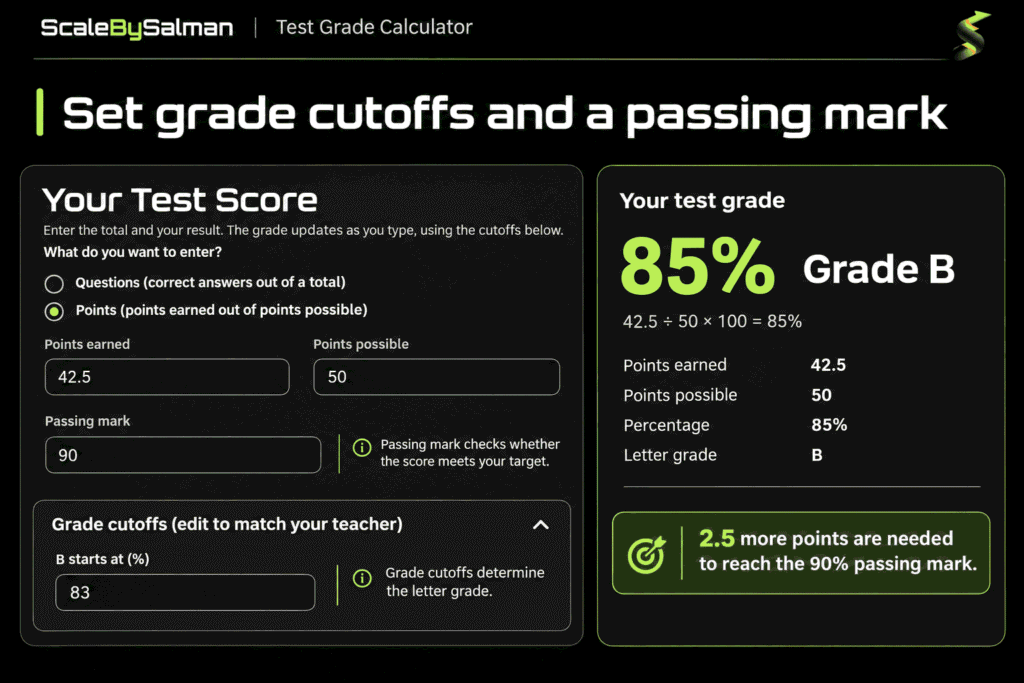
- Optional: add a passing mark, or edit the grade cutoffs to match your class.
When there is a higher grade to reach, the results show how many more answers or points would reach it. They also list the minimum score for every letter grade.
See the Calculator in Action
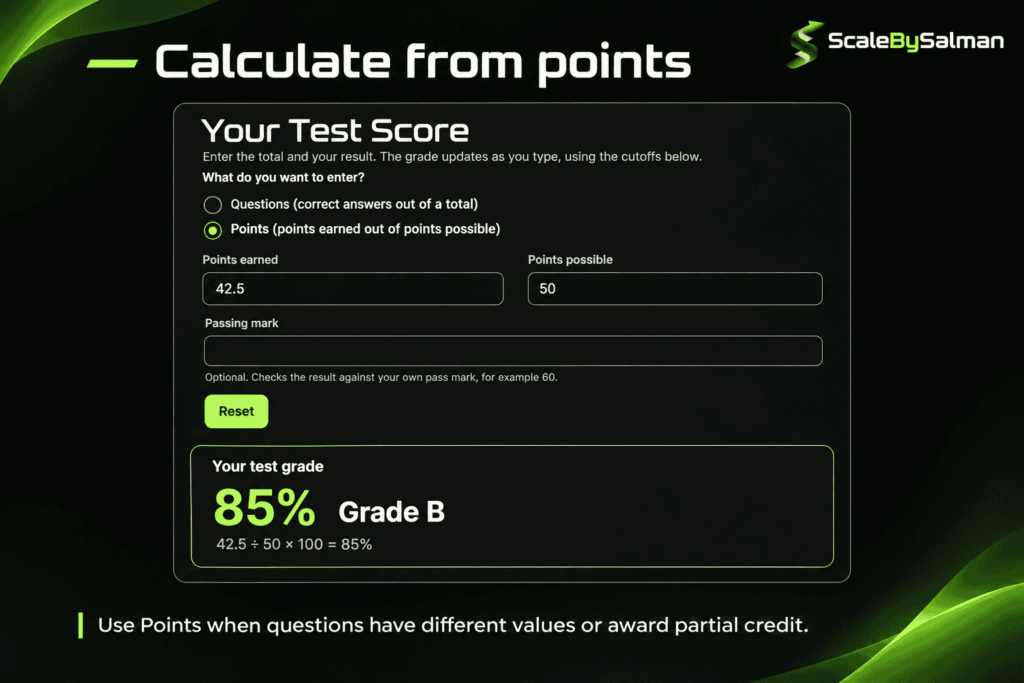
Pick a tab to see each way of using the calculator. All three examples score 85%, so you can compare how the inputs differ.
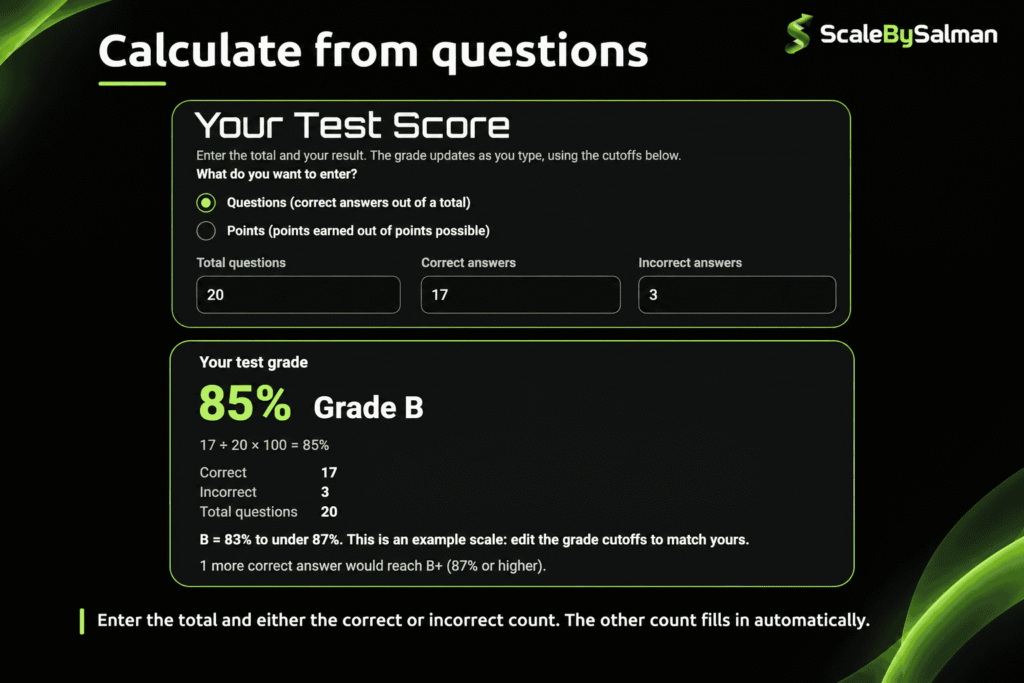
Questions mode: enter the total and either the correct or the incorrect count. The other count fills in automatically. 17 ÷ 20 × 100 = 85%.
Easy Grade Chart for Teachers
Grading a stack of quizzes or exams with the same number of questions? In Questions mode, enter the total with any score, then open Show every score under the results. You get each possible number correct with its percentage and letter grade, based on your cutoffs. The list is available for tests of up to 100 questions.
Calculating a course grade? Use the Final Grade Calculator to find the final-exam score you need to reach your target course grade. Use the Semester Grade Calculator to combine quarter grades with a weighted exam score.
Frequently Asked Questions
How do I calculate my test grade?
If every question is worth the same and there’s no partial credit, divide the number correct by the total that counts toward your grade and multiply by 100. For example, 18 out of 25 is 72%.
What percentage is an A on a test?
Check your teacher’s grading scale. In the calculator’s letters-only preset, A starts at 90%. In the default plus/minus preset, A starts at 93%, and 90% to below 93% earns an A−.
Does rounding affect my grade?
It can. The calculator displays the percentage to a maximum of two decimal places and uses the exact score to choose the letter grade. Check your teacher’s rounding rule if your score is close to a cutoff.
How much is each question worth?
If all questions carry equal marks, each one is worth 100 divided by the total number of graded questions, in percentage points. On a 25-question test, each question is worth 4 percentage points.
What is 20 out of 25 as a grade?
It is 80%, which is a B− on the calculator’s default plus/minus preset and a B on its letters-only preset. Your teacher’s scale may differ.
What is 15 out of 20 as a percentage?
It is 75%. Divide 15 by 20 and multiply by 100.
How do I calculate a test grade from wrong answers?
For an equally weighted test with no partial credit, subtract the number marked incorrect from the total graded questions. Divide the correct count by the total and multiply by 100. Count unanswered questions as incorrect if your teacher does.
How do I calculate a grade with partial credit?
Use Points mode. Enter the points you earned, including partial credit, and the total possible. For example, 42.5 out of 50 points is 85%.
How does one test affect my course grade?
It depends on the grading policy. If a test counts directly for 25% of the course grade and you score 80%, it contributes 20 percentage points toward the full course grade. If the test belongs to a weighted category, first check how scores within that category are combined.
Can I use this for a quiz or an exam?
Yes. Use Questions for a single quiz or exam with equally weighted questions and no partial credit. Use Points if questions carry different values or you earned partial credit.
Free calculators
More free calculators
Pick the next tool for what you're working out. Each one shows its formula and assumptions, and none needs an account.
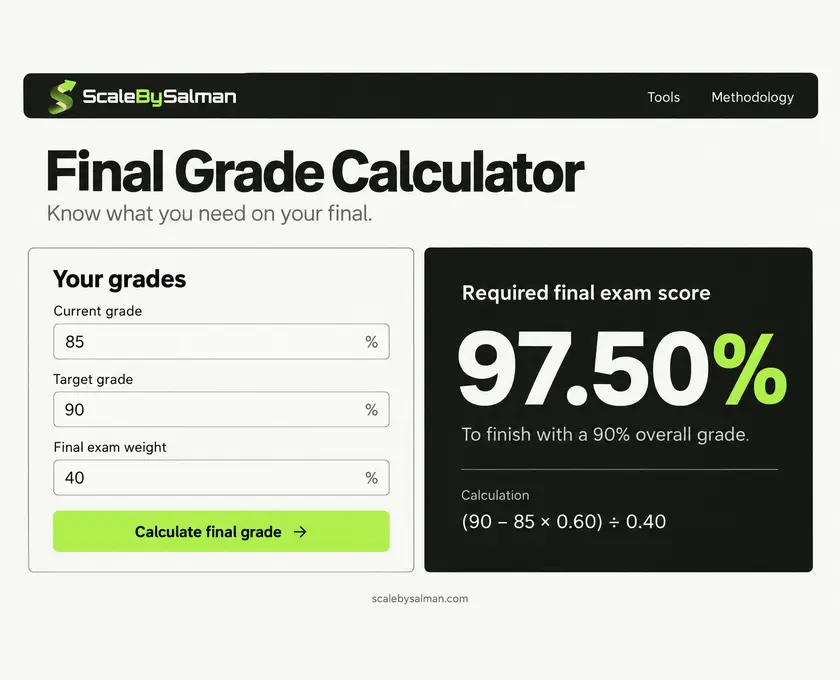
Final Grade Calculator
Find the exam score you need to reach your target course grade.
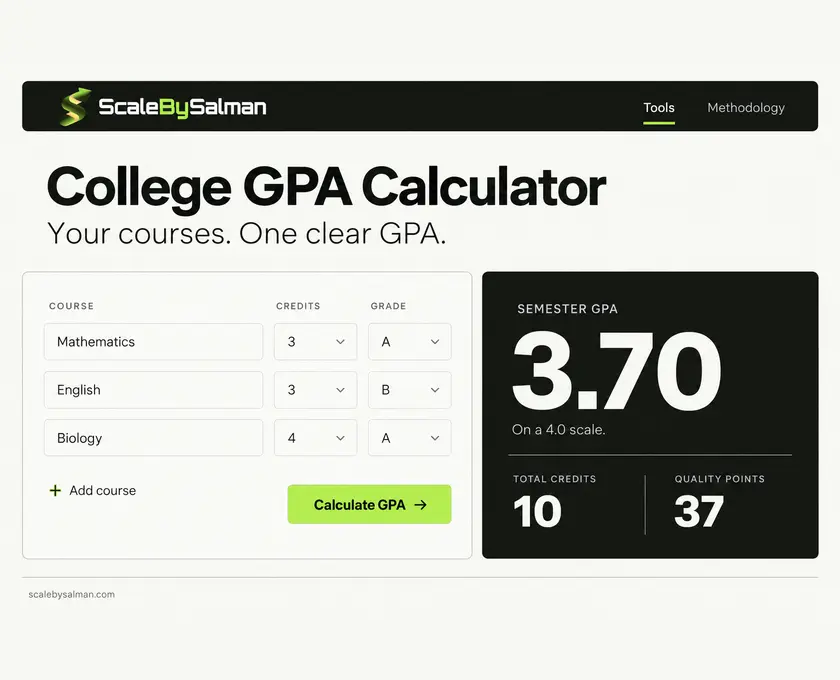
College GPA Calculator
Calculate semester and cumulative GPA from course grades and credit hours.
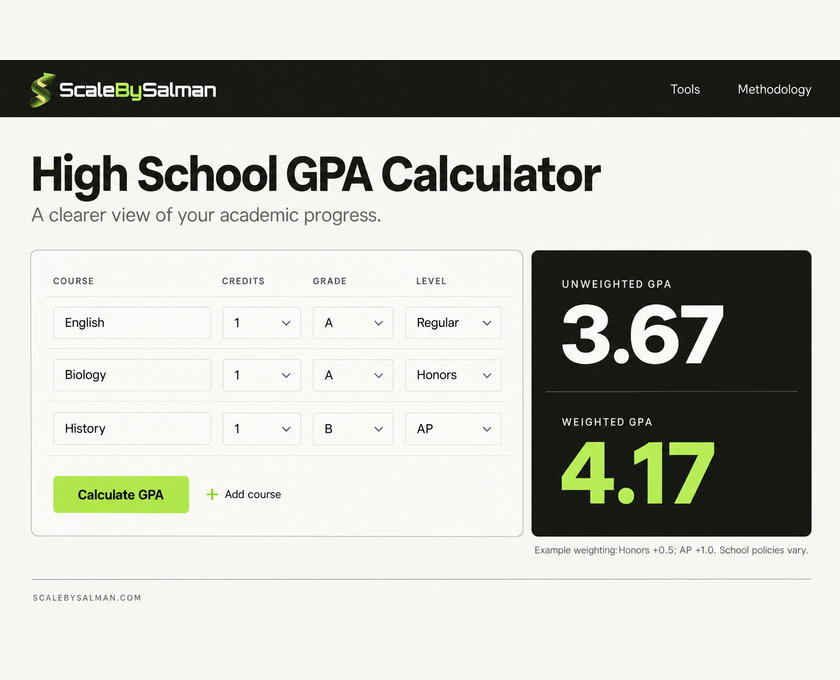
High School GPA Calculator
Weighted and unweighted GPA from course grades, levels and credits.
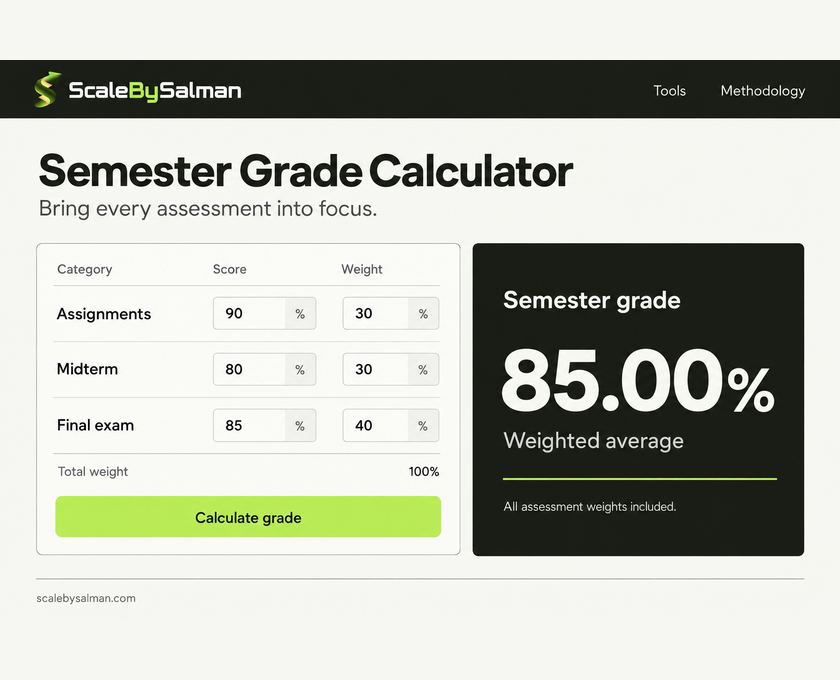
Semester Grade Calculator
Combine quarter grades and exam weights into one semester result.
Related guides
- Test score to grade chart: common scores and their letter grades.
- What score do you need to pass?: turn a pass mark into points.
- How to calculate test percentage: from questions, marks or points.
Looking for something else? See all the free tools, read more in the guides library, or go back to the ScaleBySalman homepage. Questions about your data or our rules? Read the privacy policy and the terms of use, and see our advertising disclosure.
Limitations and Sources
This calculator works out the percentage of a single test and shows a letter grade from an example scale you can edit. It is an estimate, not an official grade: schools and teachers set their own cutoffs, rounding and passing marks, so always confirm with your syllabus. The formula is the arithmetic definition of a percentage; the grading scales above are examples, not a source for any particular school's policy. For background on how grading scales differ between schools, see Academic grading in the United States, and rely on your own course syllabus for your school's scale.