
Your unweighted GPA is the plain version of your grade point average. It treats every class the same. An A in regular English is a 4.0, and an A in AP Calculus is also a 4.0. No bonus points for harder courses.
That's why colleges and scholarship forms often ask for it. It's a simple, comparable number. Here's how to work it out yourself, and what to do if all you have is your weighted GPA.
Rather not add it up by hand?
The High School GPA Calculator shows your weighted and unweighted GPA side by side, so you can check your work in seconds.
Try the GPA calculator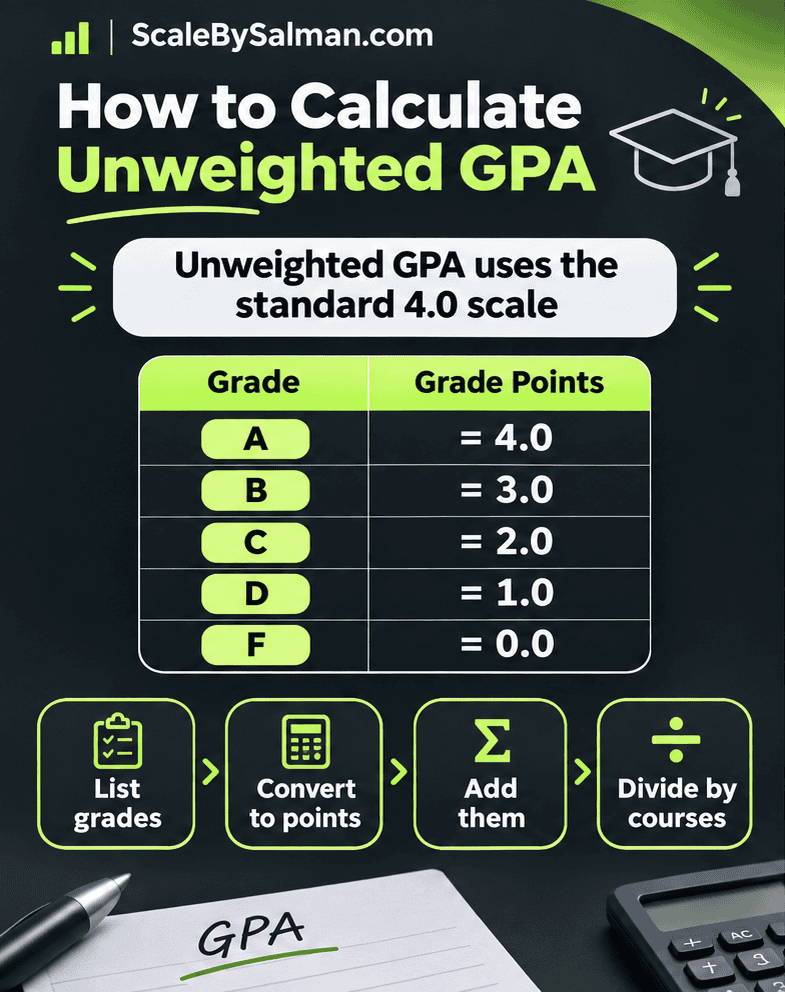
The standard 4.0 scale and the four steps, on one card.
Weighted GPA adds extra points for advanced courses. At many schools an honors class might add 0.5 and an AP or IB class might add 1.0, so an A can count as 4.5 or 5.0. The exact bonus is up to each school.
Unweighted GPA removes that bonus. Every course uses the standard 4.0 scale, so the highest possible GPA is a 4.0. If you want the full comparison, the guide on weighted vs unweighted GPA covers when each one gets used.
Most schools convert letter grades to points like this. Some schools skip the plus and minus, so use your own school's scale if it's different.
If every course carries the same credit, you can take a simple average. Here's a worked example with five courses:
Your unweighted GPA is 3.34. Notice the honors and AP classes didn't change anything. They count like any other class.
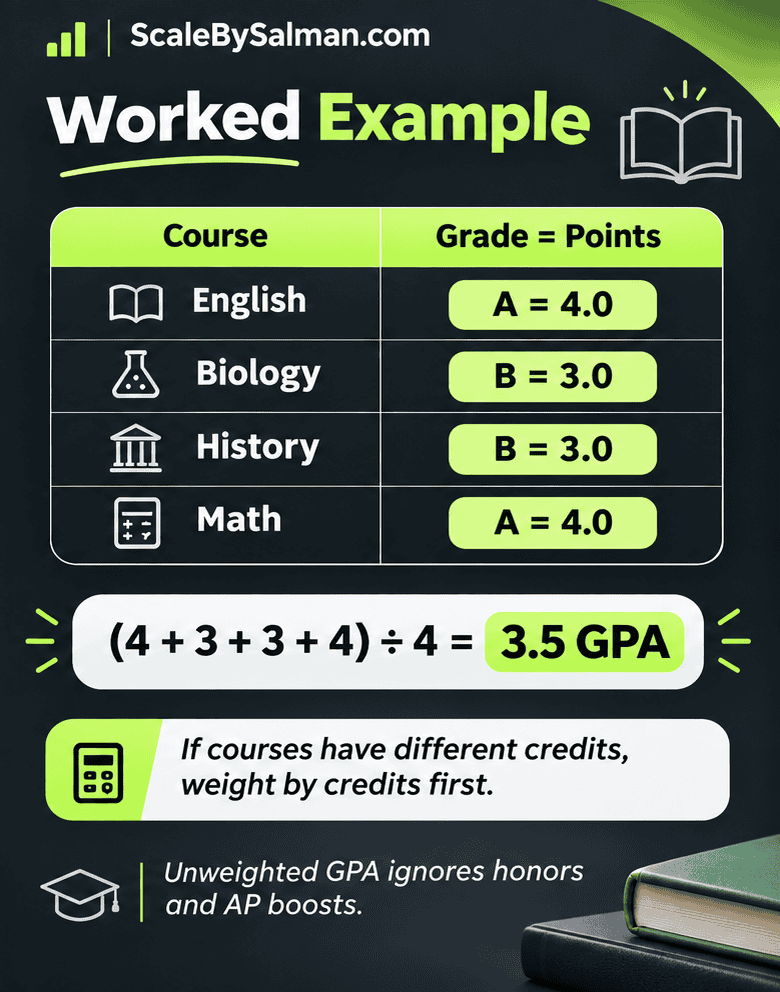
Same method, simpler numbers: four courses and a 3.5 GPA.
Some classes count for more. A full-year course might be 1.0 credit and a half-year elective 0.5. In that case, multiply each course's grade points by its credits before adding.
Take the same student with an added half-credit PE class (grade A, 4.0), and say the other five are one credit each:
Total quality points divided by total credits is the formula that works every time. The High School GPA Calculator handles credits and shows weighted and unweighted GPA side by side.
This is the question that causes the most confusion, so let's be direct: you can't reliably convert a weighted GPA number into an unweighted one. A weighted 3.8 could come from lots of different mixes of grades and course levels.
What you can do is rebuild it from the grades. That's the honest way to find unweighted GPA from weighted results.
If your school's weighted GPA adds a flat 1.0 to every AP course, you can sometimes work backward by subtracting those bonus points, but only if you know exactly which courses got the bonus and how much. Guessing from the final number gives you a wrong answer more often than a right one.
Here's the one case where working backward does work. Suppose a student has five courses, one honors (+0.5) and one AP (+1.0), and a weighted GPA of 3.64. The bonuses add 1.5 points across five courses, which is 0.3 per course on average. Take 0.3 off and you get 3.34, matching the unweighted GPA in our example above. It only works because every bonus is known. Change one assumption and the answer changes.
Strictly speaking, you don't convert it, you recalculate it. A conversion would need one formula that works for every school, and there isn't one. Some schools add 0.5 for honors, others add 1.0, and some cap the weighted scale at 4.5 or 5.0. Ask your counselor for an unweighted figure or use your letter grades.
Even when you follow these steps perfectly, your result may not match your school's. Schools make different choices:
The official number is the one on your transcript. Use your own calculation to plan, not to argue. If you need an official unweighted GPA for an application, ask your counselor or registrar.
A mostly-B student should land around 3.0. A mix of As and Bs should sit between 3.3 and 3.7. If your calculation looks off, double-check that you used the right points for minus grades and divided by the right total. Those two slips cause most errors.
Once you've got your unweighted number, you might want to see how it stacks up. The guide on what counts as a good GPA puts it in context. For the full walk-through of the basics, read how to calculate GPA, and for a high school specific version, see how to calculate high school GPA.
If you're working through your GPA, these pick up where this page leaves off:
Convert each final letter grade to grade points on the 4.0 scale, multiply by credits if courses differ, add everything up, and divide by total credits. With equal credits, it's just the average of your grade points.
You usually can't convert the number directly. You need your individual letter grades and credit hours, then recalculate on the standard 4.0 scale without any bonus for honors, AP or IB classes.
Not reliably from the GPA alone. Different schools add different bonuses, and the same weighted GPA can come from many different grade combinations. Rebuild it from your transcript's letter grades instead.
Check your transcript or student portal, since many schools print both numbers. If it only shows a weighted GPA, ask your counselor, or calculate it from your letter grades and credits.
On a standard 4.0 scale, 4.0 is the highest. Some schools give A+ a 4.3, but most unweighted GPAs top out at 4.0.
Unweighted GPA is your average on a plain 4.0 scale, with no extra credit for harder classes. Convert letters to points, weight by credits, divide by total credits. If you only have a weighted number, go back to the letter grades and rebuild it. The High School GPA Calculator will do the arithmetic for you.
ScaleBySalman has free calculators for GPA, grades and final exams, and none of them needs an account. Start from the ScaleBySalman homepage, browse the full free tools directory, or read more in the guides library. Questions about your data or our rules? Read the privacy policy and the terms of use, and see our advertising disclosure.
Browse all tools