
Use this high school GPA calculator to work out your weighted and unweighted GPA from course grades, course levels and credits. It works as a GPA calculator for high school students at any grade level: add one term or every term, include Honors, AP, IB and Dual Enrollment courses, enter a prior GPA record, and adjust the grading policy to match your school’s GPA scale.
How This High School GPA Calculator Works
Add your courses, pick each grade and course level, and enter the credits each course counts for. The calculator shows an unweighted GPA and a weighted GPA side by side, with a table of how each course contributed. Add more terms to cover every semester or year, or enter a prior record if you do not have the older courses. It works as both a weighted GPA calculator and an unweighted GPA calculator: the same courses and grades produce both results at once, so you do not need to enter them twice.
Everything depends on the policy shown under Grade policy: the grade points, the bonus for Honors, AP, IB and Dual Enrollment courses, and which grades earn that bonus. The defaults are an example, not any school's official policy, so edit them to match your school.
How to Calculate Your High School GPA
- Choose whether courses are weighted by actual credits or counted equally.
- For each course choose a grade (or enter a percentage if you switch the term to percentages), a level and its credits.
- Mark a course as excluded if your school leaves it out, for example a pass or withdrawal. Excluded courses stay visible with the reason.
- Press Calculate or Enter. Change anything afterwards and the result is marked as needing recalculation.
- Open Grade policy to change grade points, bonuses or percentage cutoffs, and Cumulative GPA to add terms or a prior record.
Weighted and Unweighted GPA Formulas
GPA = total quality points ÷ total GPA credits, where a course's quality points are its credits × its grade points.
High School GPA Calculation Example
Four one-credit courses on the example scale: A (Regular), B+ (Honors), A- (AP) and B (Regular). Base points are 4 + 3.3 + 3.7 + 3 = 14, so the unweighted GPA is 14 ÷ 4 = 3.50. With the example bonuses (Honors +0.5, AP +1) the weighted points are 4 + 3.8 + 4.7 + 3 = 15.5, so the weighted GPA is 15.5 ÷ 4 = 3.875, shown as 3.88.
Unweighted GPA uses each course’s base grade points without an additional course-level bonus. Weighted GPA adds the configured bonus for eligible advanced courses, such as Honors, AP or IB. Both calculations can still account for course credits, so unweighted does not necessarily mean every course counts equally.
Weighted GPA adds the bonus for an eligible course level to the grade points before multiplying by credits.
Equal-course counting gives every included course one unit. Use it when the courses should count equally. If credits are unavailable, it can provide an estimate, but the result may differ from a transcript that weights courses by credit.
Credits matter: an A in a 1-credit course and a B in a 0.5-credit course give (4 + 1.5) ÷ 1.5 = 3.666…, shown as 3.67, not the 3.50 you get by counting the courses equally.
High School GPA Scale: Grade Points, Honors and AP Bonuses
Schools use different grade-point scales, so there is no single high school GPA scale. Many report an unweighted GPA on a 4.0 scale, where an A is 4.0, a B is 3.0 and a C is 2.0, and a weighted GPA that can rise above 4.0 because Honors, AP, IB or Dual Enrollment courses earn a bonus. How big the bonus is, and which grades earn it, is set by each school. The calculator keeps all of this in the Grade policy panel, so you can match your own school’s policy instead of relying on a default.
Percentage Grades to GPA
If your grades are percentages, switch the term to percentages and enter each score. The calculator converts it using the percentage table in your grade policy. On the example table a 93 is an A, worth 4.0, but another school’s table may map the same score differently, so check your school’s scale before you rely on the result.
Weighted vs Unweighted GPA: Which One Do You Need?
Unweighted GPA shows your grades on the standard scale. Weighted GPA adds credit for course difficulty. Transcripts often show one or both, and an application or scholarship program may ask for a specific one, so read the instructions of the school or program you are applying to. The calculator gives both from the same entries, so you can compare them without typing anything twice.
How to Calculate Cumulative High School GPA
Entering every term is the most accurate way to get a cumulative GPA: the calculator adds all quality points and all credits and divides, instead of averaging term GPAs. A 1-credit term at 4.0 and a 3-credit term at 2.0 give (4 + 6) ÷ 4 = 2.50, not 3.00.
If you only have a prior GPA, enter it with its GPA credits: (prior GPA × prior credits + new quality points) ÷ (prior credits + new credits). For example 30 prior credits at 3.2 plus 15 new credits at 3.8 give (96 + 57) ÷ 45 = 3.40. Weighted and unweighted prior records are separate: one cannot be worked out from the other, so a missing weighted record means no weighted cumulative result. A prior GPA is usually rounded, so the result is an approximation. If you change the grade points, bonuses, eligibility or credit basis after entering a prior record, it is kept but no longer used until you enter a compatible one.
What GPA Do I Need Next Term to Reach My Target?
To plan toward a target, work out how many quality points you still need. Required GPA for the coming term = (target GPA × total GPA credits after the term − current quality points) ÷ credits in the coming term, where current quality points = current GPA × current GPA credits. Use the same scale (weighted or unweighted) for all three numbers.
Example on an unweighted 4.0 scale: you have a 3.40 GPA over 24 GPA credits (3.40 × 24 = 81.6 quality points) and want a 3.50 after 6 more credits. The target needs 3.50 × 30 = 105 quality points, so you need (105 − 81.6) ÷ 6 = 3.90 in the coming term. If the number you need is above your school’s highest grade-point value, the target cannot be reached in one term and has to be spread over more terms. To check a plan, add the courses you expect to take as a new term in the calculator above and enter the grades you are aiming for.
Is this a UC GPA calculator?
No. This calculator estimates GPA using the courses and grading policy you enter. The University of California applies its own rules for eligible courses, grade periods and honors points. Use UC’s official GPA instructions when checking its admissions requirements.
Source of Official GPA Instructions
Grading Policies and Calculator Limitations
- Schools differ on grade points, plus and minus values, bonuses, which courses count and how repeats are handled. For example Broward distinguishes state, district and core GPAs, Fairfax County removed the D- mark for 2025-26, and the University of California counts only certain courses and years, ignores pluses and minuses and does not give an honors point for a D or F.
- This calculator is not the University of California method or any named school's method, and does not predict admissions outcomes.
- Repeated courses are not replaced automatically. Mark the attempt your school does not count as excluded, and make sure it is not already inside a prior record.
- Credits here are GPA-counted attempted credits, not graduation credits.
- In this version an F never earns a bonus, even if a school's policy differs.
- Up to 12 terms and 20 courses per term. Your entries stay in your browser and are not saved or placed in the page address.
- The result is an estimate. Your school's transcript GPA is the official one.
Frequently Asked Questions
How do I calculate my GPA for high school?
Convert each grade to grade points using your school's scale, multiply by the course credits, add those quality points and divide by the total credits. For weighted GPA, add your school's bonus for Honors, AP or similar courses before multiplying. A longer walk-through with a worked semester is in how to calculate high school GPA.
What is the difference between weighted and unweighted GPA?
Unweighted GPA ignores course difficulty. Weighted GPA adds a bonus for advanced courses, so it can go above the normal maximum. Both can still use credits to weight each course. For the plain version, see how to calculate unweighted GPA.
Can I calculate without credits?
Yes. Choose equal-course counting and every included course counts once. If your school weights courses differently, actual credits will be closer to your transcript.
Is a 3.7 GPA an A or a B?
A cumulative GPA is not a single course grade, so it is not uniquely either. On the example scale a 3.7 is the grade-point value of an A-, but a 3.7 average can come from many mixes of grades.
Is a 93 a 4.0 GPA in high school?
Only if the scale you use maps a 93 to an A and an A to 4.0. On this page's example percentage table a 93 is an A, worth 4.0, but another school's table may differ.
Is a 2.7 GPA bad in high school?
This calculator does not judge a GPA or predict admissions. What a 2.7 means depends on your school's scale, your goals and the programs you are considering, so ask your counselor.
How are F grades, withdrawals and passes handled?
An included F counts with 0 points. Pass, no pass, incomplete and withdrawal courses can be excluded, and each excluded course stays listed with its reason. Check your school's rules before choosing.
Why does my transcript show a different GPA?
Your school may use a different scale, bonus, rounding rule, repeat policy or set of included courses, and a rounded prior GPA also makes a cumulative result approximate. If you only need the official number, how to find your GPA explains where to look.
Sources and School Grading Policies
- Broward County Public Schools grading and GPA guidance: separate unweighted, weighted and core GPAs, with grade-dependent extra points.
- Fairfax County Public Schools postsecondary profile: its 2025-26 grading scale.
- University of California first-year GPA requirement: how its admissions GPA is calculated.
Last reviewed: 15 October 2026.
Free calculators
More free calculators
Pick the next tool for what you're working out. Each one shows its formula and assumptions, and none needs an account.
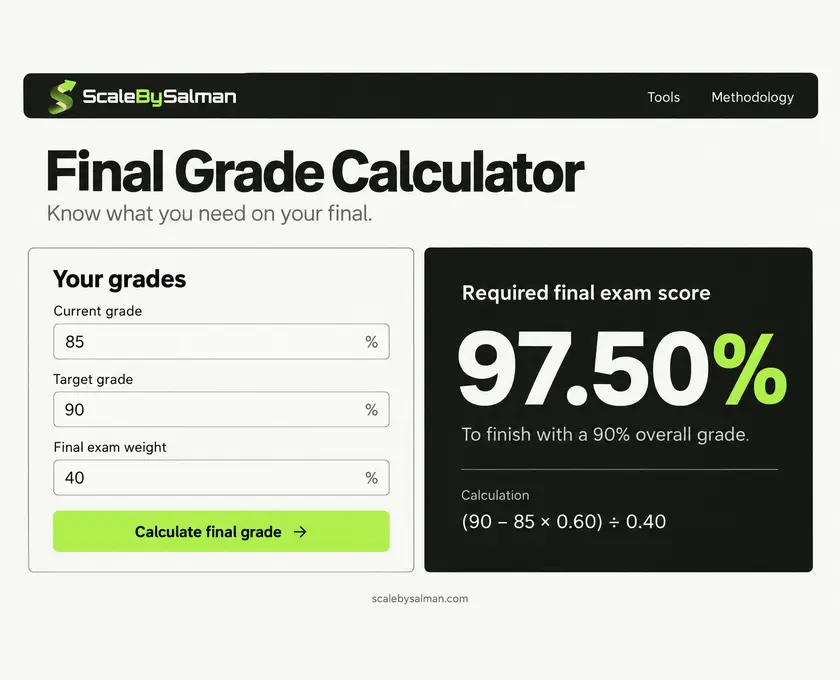
Final Grade Calculator
Find the exam score you need to reach your target course grade.
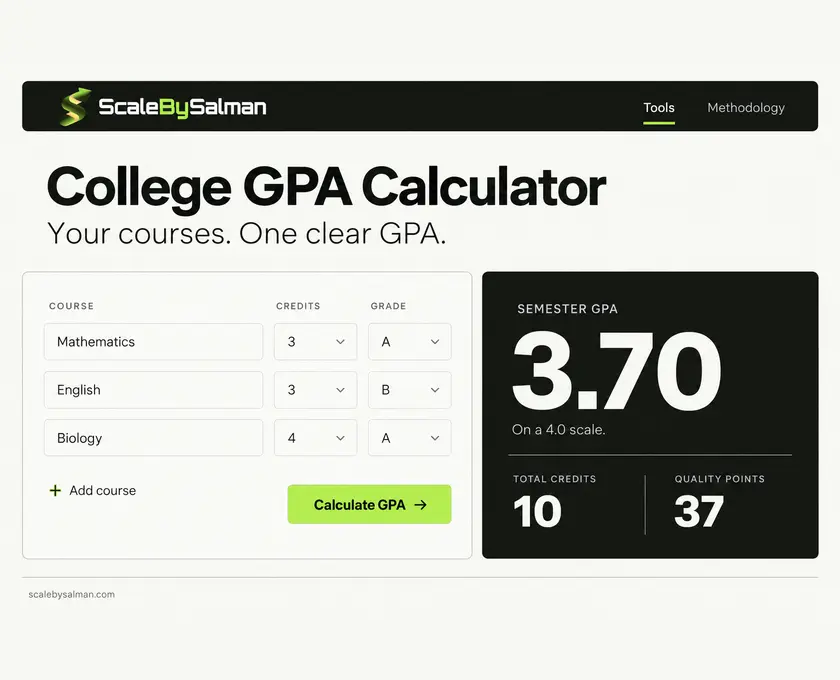
College GPA Calculator
Calculate semester and cumulative GPA from course grades and credit hours.
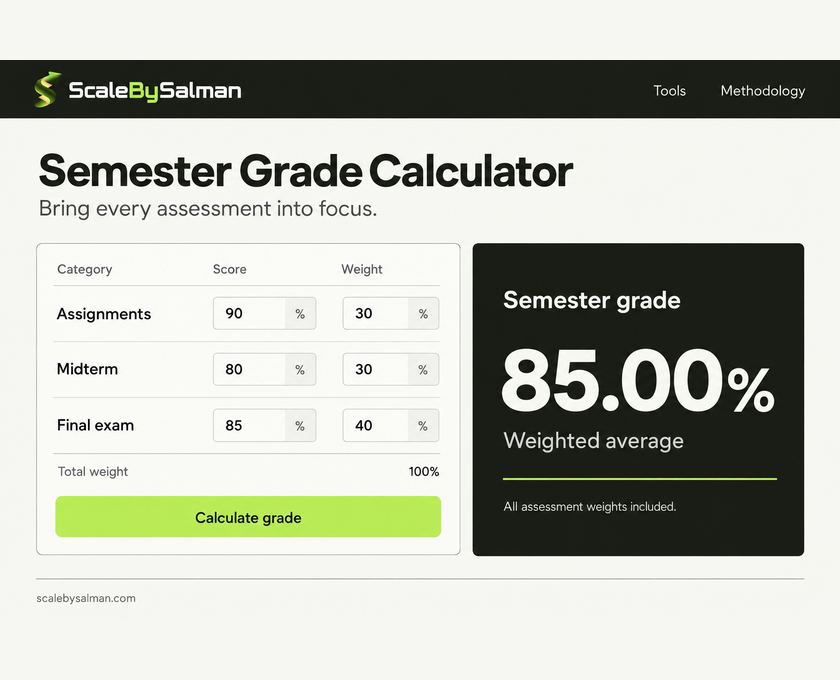
Semester Grade Calculator
Combine quarter grades and exam weights into one semester result.
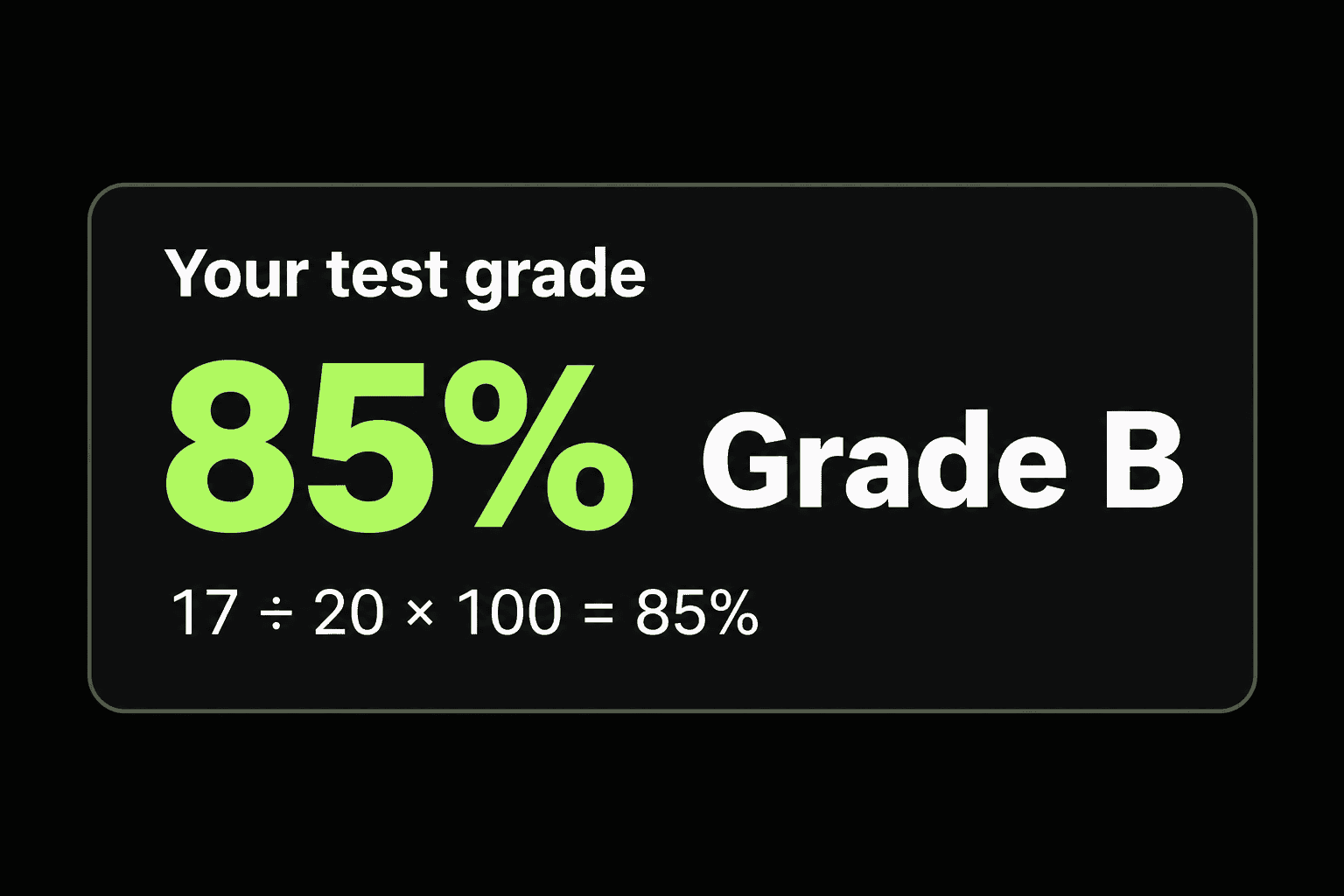
Test Grade Calculator
Turn a test score, in questions or points, into a percentage and letter grade.
Related guides
- How to calculate high school GPA: semester and cumulative, with honors and AP weighting.
- How to calculate unweighted GPA: the plain 4.0 version, step by step.
- Weighted vs unweighted GPA: what changes, and which one colleges use.
Looking for something else? See all the free tools, read more in the guides library, or go back to the ScaleBySalman homepage. Questions about your data or our rules? Read the privacy policy and the terms of use, and see our advertising disclosure.
Related Grade and GPA Calculators
College GPA Calculator: Calculate semester and cumulative college GPA using college course grades and credits.
Final Grade Calculator: Find the score needed on a single final exam to reach your target course grade.
Semester Grade Calculator: Combine quarter or term grades and exam weights to calculate a grade for one course.
Weighted vs Unweighted GPA: What's the Difference?: See how weighted and unweighted GPA differ, with a side-by-side example.
How to Calculate GPA: Formula, Steps and Examples: The method behind any GPA, with worked examples.
What Is a Good GPA? How to Judge Yours: What a GPA number means and what changes it.