
If you've ever stared at a returned test and wondered how the teacher got from "34 correct" to "85%," this guide is for you. Learning how to calculate percentage on a test takes one division and one multiplication. Once you've done it twice, you'll never need to look it up again.
Here's the whole idea in one line: percentage = (what you got ÷ what was possible) × 100. Everything else on this page is just that formula applied to different situations, like marks, points, wrong answers and partial credit.
Want to check your working?
Type your numbers into the Test Grade Calculator. Points mode handles partial credit, so the answer matches what's on your paper.
Open the calculator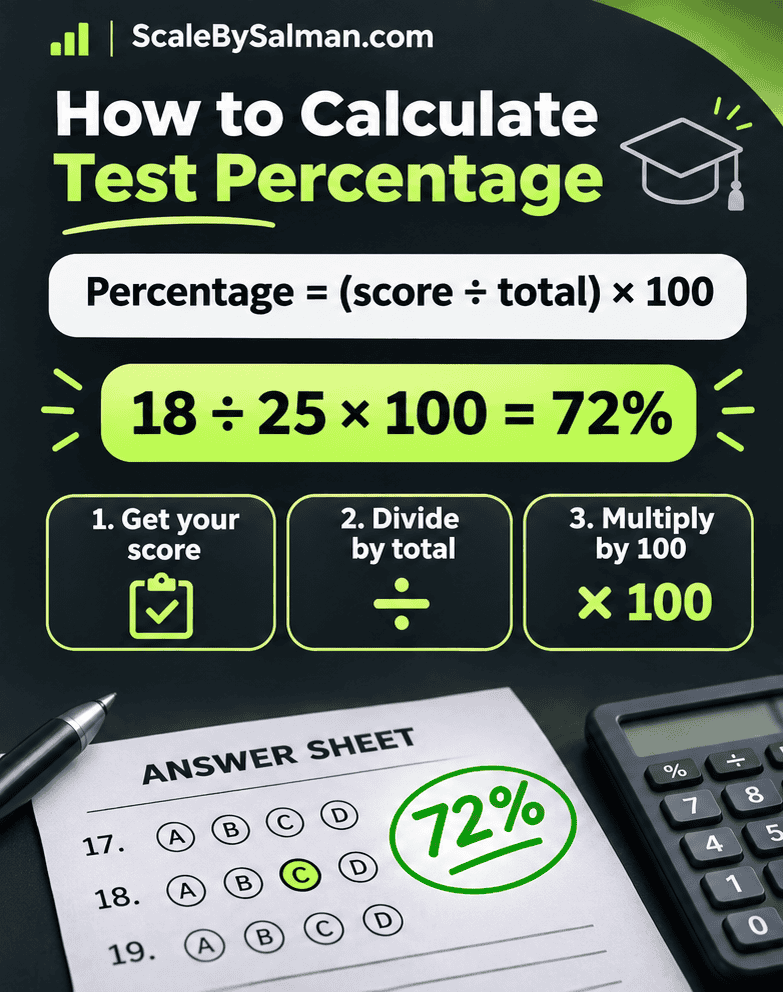
Three steps, one formula. Try it with your own score.
Let's use a 40-question test where you got 34 right.
That's the answer. If you'd rather skip the arithmetic, the Test Grade Calculator does it as you type and shows the letter grade too.
A tip that saves mistakes: always divide the smaller number by the bigger one. If your result is greater than 1, you flipped them.
Teachers often mark what you missed, not what you got right. No problem. Work out the correct answers first.
Correct = total − wrong. On a 30-question quiz with 6 wrong, you got 30 − 6 = 24 right. Then 24 ÷ 30 = 0.80, so 80%.
You can also do it in one go: ((total − wrong) ÷ total) × 100. For the same quiz, that's ((30 − 6) ÷ 30) × 100 = 80%. Use whichever feels easier on a calculator.
Not every test counts questions. If it's graded out of points or marks, the formula doesn't change. You just swap "correct answers" for "points earned" and "total questions" for "points possible."
If you're after how to calculate grade percentage from points across a whole class, the same rule applies, but you'd add up all points earned and divide by all points possible. For categories with different weights, see how to calculate weighted grades.
Here's where counting questions gets you into trouble. Say a test has 20 multiple-choice questions worth 1 point each and 2 essays worth 10 points each. That's 40 points in total, not 22.
If you got 16 multiple-choice right and scored 8 and 7 on the essays:
If you'd counted questions instead, you'd have gotten the wrong answer. That's why partial credit and weighted questions always call for points, not question counts. The Points mode in the Test Grade Calculator is built for this.
Some exams use negative marking, where a wrong answer costs you marks. The exact rule comes from the exam's instructions, so don't guess. A typical setup awards 4 marks per correct answer and deducts 1 mark per wrong answer, with blanks scoring zero.
Say there are 40 questions, so the maximum is 160 marks. You answer 30 correctly, 10 wrongly and leave none blank:
If you're working out how to calculate exam percentage for a paper with sections, add up the earned marks across sections, add up the maximum marks, then divide once at the end.
Once you have a percentage, you compare it with your teacher's grading scale. On the common US plus/minus scale, 85% is a B (83% to under 87%). On the simple 10-point scale, it's a B too (80% to under 90%).
The two scales don't always agree. 80% is a B− on one and a B on the other. The score-to-grade chart lays out common scores on both scales so you can see the difference.
A small rule that prevents big arguments: keep the full decimal until the final step. Then round once.
Suppose you scored 43 out of 48. That's 89.58%. Keep the decimals and compare to the cutoff, and you're a B+ (87% to under 90%). Round to the nearest whole number and you get 90%, which is an A−. Round the division to 0.90 before multiplying and you'd also land on 90%. Same test, different letter, all because of when the rounding happened. Near a boundary, ask your teacher how they round.
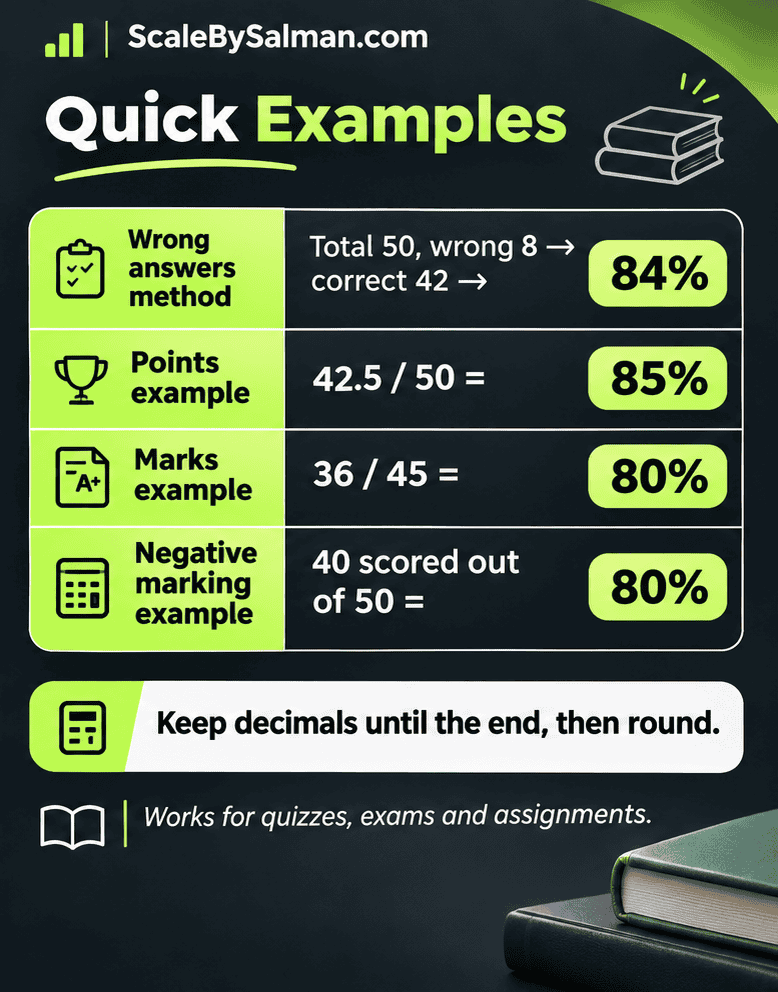
Four ways the same formula shows up. Keep decimals until the last step.
Work these out on paper, then check against the answers below.
Answers: (1) 90%. (2) 35 − 14 = 21 correct, and 21 ÷ 35 = 60%. (3) 74%. (4) 80%. (5) 73.3%. If you got four or five, you've got the method down. If you'd rather check your own numbers, the Test Grade Calculator shows the percentage and letter grade as you type.
Percentage in hand, the next question is usually "is that enough?" At most US schools, 60% is the lowest passing mark. Our guide on what score you need to pass shows how to work out how many questions you could miss before dropping under your pass mark.
A test percentage is just one input. If your teacher weights tests at, say, 40% of the course, a single 85% doesn't mean an 85% class grade. The Semester Grade Calculator combines scores and weights into one overall result.
Once you have the percentage, these are the natural next steps:
Divide the number of correct answers (or points earned) by the total possible, then multiply by 100. For 34 correct out of 40, that's 34 ÷ 40 × 100 = 85%.
Subtract the wrong answers from the total to get the correct answers, then use the same formula. With 6 wrong on a 30-question test, you got 24 right, which is 24 ÷ 30 × 100 = 80%.
Divide the marks you scored by the maximum marks, then multiply by 100. For 68 out of 80, that's 68 ÷ 80 × 100 = 85%.
Divide your points earned by the points possible and multiply by 100. For 42.5 out of 50, that's 85%. Use points, not question counts, when questions are worth different amounts.
Add the points you earned across all sections, add the points possible across all sections, then divide the first by the second and multiply by 100. If sections carry different weights, use a weighted average instead.
To recap how to calculate percentage on a test: what you earned, divided by what was possible, times 100. Use points when questions aren't worth the same, round only at the end, and match the result to your teacher's scale. When you want the answer in a few seconds, the Test Grade Calculator has you covered.
Whether it's a quiz, a semester or a final, ScaleBySalman has a free calculator for it, and none of them needs an account. Start from the ScaleBySalman homepage, browse the full free tools directory, or read more in the guides library. Questions about your data or our rules? Read the privacy policy and the terms of use, and see our advertising disclosure.
Browse all tools