
Here's the question behind half the searches students make the night before an exam: "what score do you need to pass?" The honest answer is that it depends on your school and your course. But there's a default, and there's a quick way to turn it into an exact number of points or questions.
At most US schools, the lowest passing grade is 60%, which is a D− on the plus/minus scale. Plenty of courses set it higher, usually 65% or 70%, and many professional programs sit at 70% to 80%. Your syllabus is the only source that counts, so look there first.
Already took the test?
Add your own pass mark in the Test Grade Calculator and it shows how many more points you would have needed to get there.
Check against my pass mark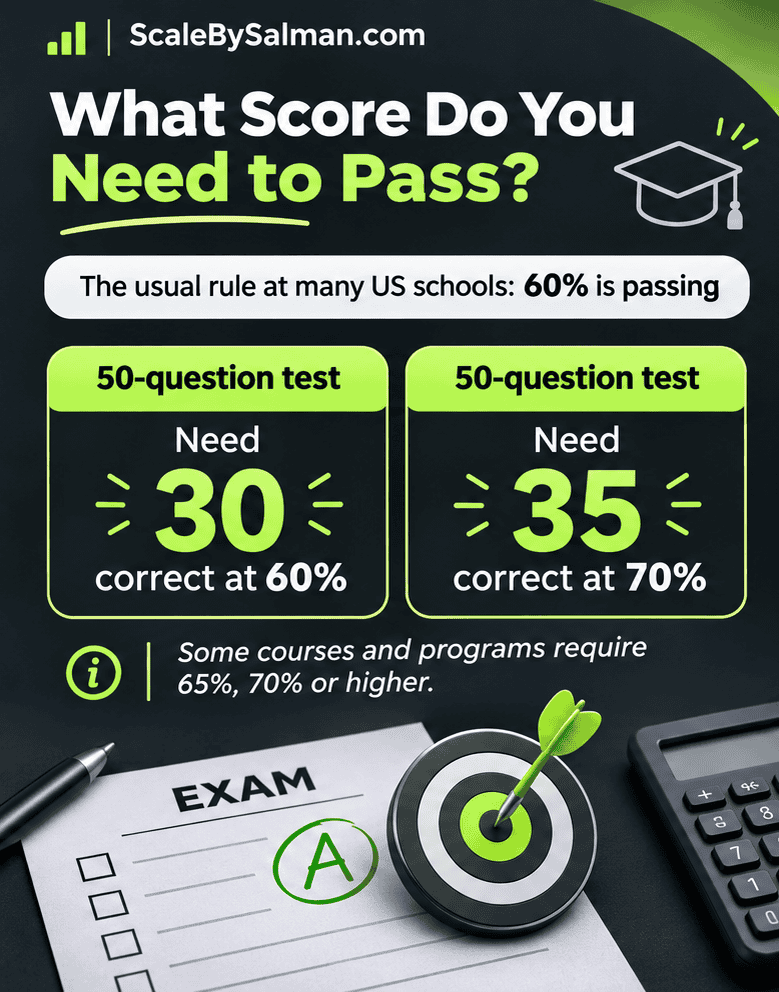
The usual 60% rule in action: 30 correct on 50 questions, or 35 if the pass mark is 70%.
Think of these as common patterns, not rules:
If you want the letter-grade side of this, the score-to-grade chart shows what each percentage looks like on both the plus/minus and 10-point scales.
This is the part worth memorizing, because it works for any test:
Minimum points = (passing percentage ÷ 100) × total points, rounded up.
That number is your minimum score, the fewest points needed to pass.
Say a test has 50 points and the pass mark is 60%. That's 0.60 × 50 = 30 points. If the pass mark is 70%, it's 0.70 × 50 = 35 points. So the "passing score of 50" question depends on what the 50 means: if it's the total, you need 30 at 60% or 35 at 70%. If the pass mark is itself a raw score of 50 points, the total tells you what percentage that is.
Why round up? Because you can't earn 0.2 of a question, and falling short by a fraction still falls short. A 25-question test at 60% needs exactly 15 right. A 25-question test at 65% needs 16.25, so you need 17 correct, not 16.
Once you know the minimum correct answers, the maximum you can miss is just the total minus that number. Here's a quick reference for common test sizes. Each line shows the most questions you can get wrong, and how many you need right, at each pass mark.
Read it like this: on a 40-question test with a 70% pass mark, you can miss up to 12 questions (you'd need 28 right). Those numbers assume every question is worth the same. If some questions carry more weight, switch to points and use the same formula on the total points.
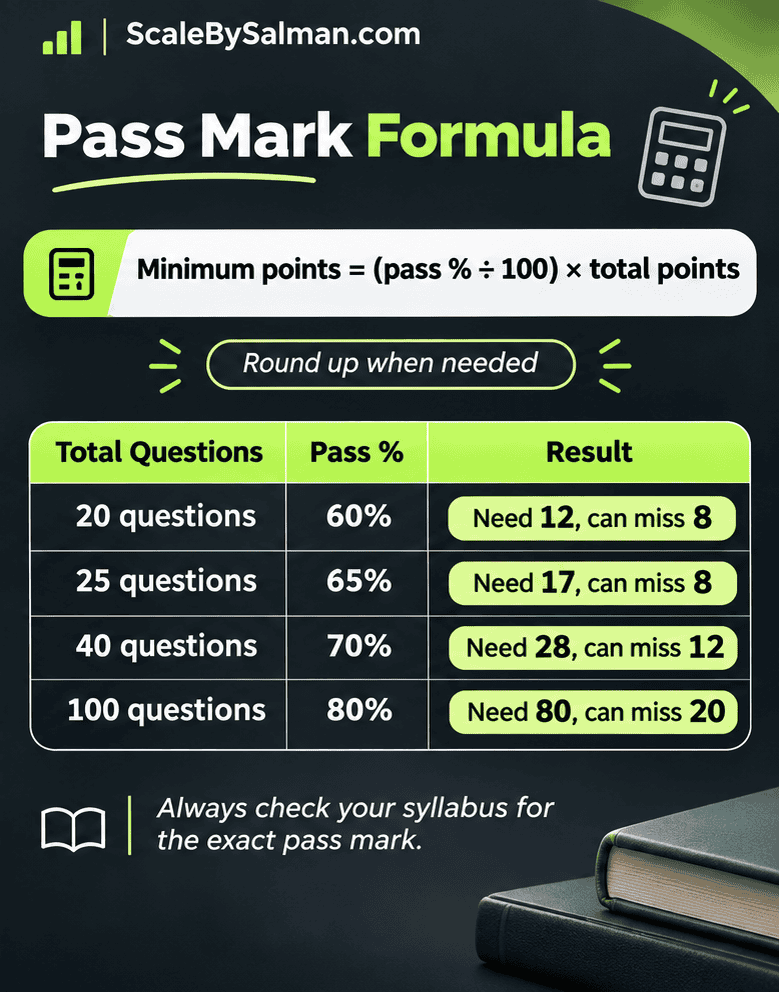
Minimum points = (pass % ÷ 100) × total points, rounded up. The miss counts above come straight from this.
The quick reference does more than answer a curiosity. It tells you how much slack you've got. On a 25-question quiz with a 70% pass mark you can only miss 7, so every question matters. On a 100-question exam at the same pass mark you can miss 30, so one tricky section won't sink you. When your slack is small, spend your last study session on the topics you're least sure about. When it's big, you can afford to skim the rest.
Imagine a 50-question multiple-choice exam with a 70% pass mark. Here's how it plays out.
So you can miss 15 questions and still pass. Miss 16 and you're at 34 correct, which is 68%, just under the line. That one-question difference is exactly why it helps to know your number before the test, not after.
A pass mark and a letter grade describe the same line from two directions. If a course passes at 60%, that's a D− on the plus/minus scale and a D on the 10-point scale. If it passes at 70%, the cutoff is a C− or a C. On a 100-point test, the points needed are 60 at a 60% mark, 70 at a 70% mark and 80 at an 80% mark. Our score-to-grade chart shows the letter for scores in between, which helps when your teacher talks in grades and the exam talks in points.
Sometimes the real question isn't "what do I need on this test" but "what do I need on the final to pass the class." That's a different calculation, because your current grade and the final's weight both matter. The guide on what you need on your final and the Final Grade Calculator handle that. You enter your current grade, the grade you want, and how much the final counts.
If you've already taken the test and want to know where you landed, the Test Grade Calculator does it in a few seconds. Enter the total and your correct answers, or switch to Points mode. Add your own passing mark and it tells you how many more points you'd have needed, which takes the guesswork out of the "so close" feeling.
Depending on where you are in the course, these might help next:
At most US schools, you need 60% or higher, which is a D−. Many college courses and professional programs require 70% or more. Check your syllabus for the exact pass mark, because it varies by school and course.
Multiply the total points by the pass percentage as a decimal, then round up. A 100-point test at 60% needs 60 points. A 50-point test at 70% needs 35. A 25-point test at 65% needs 17 (16.25 rounded up).
Subtract the minimum correct answers from the total. On a 40-question test with a 70% pass mark, you need 28 right, so you can miss 12.
It depends on the pass mark. At 60%, you need 30 out of 50. At 65%, you need 33 (32.5 rounded up). At 70%, you need 35.
If the pass mark is 40%, you need 40 marks. If it's 50%, you need 50. If it's 60%, you need 60. Pass marks differ a lot by country and board, so check your exam body's rules.
Passing is a number, and numbers are easy to plan around. Find your pass mark in the syllabus, multiply it by the total, round up, and you've got your target. Then subtract from the total to see how many questions you can miss. If you've already got your score, the Test Grade Calculator will tell you where you stand.
ScaleBySalman has free calculators for grades, GPA and final exams, and none of them needs an account. Start from the ScaleBySalman homepage, browse the full free tools directory, or read more in the guides library. Questions about your data or our rules? Read the privacy policy and the terms of use, and see our advertising disclosure.
Browse all tools