
You've got your test back. There's a "32/40" circled in red, no letter, and a vague feeling you should know what that means. You don't need to hunt for a teacher's email. It's 80%, which is a B− on the plus/minus scale most US schools use, or a flat B if your school skips the plus and minus.
That's the short answer for what grade is a 32 out of 40. The rest of this page shows you how to work out any score yourself, and gives you a chart for the scores people ask about most, such as 15 out of 20, 35 out of 40 and 8 out of 14.
Skip the arithmetic
Got a score in mind? Pop it into the Test Grade Calculator and watch the percentage and letter grade update as you type.
Check my score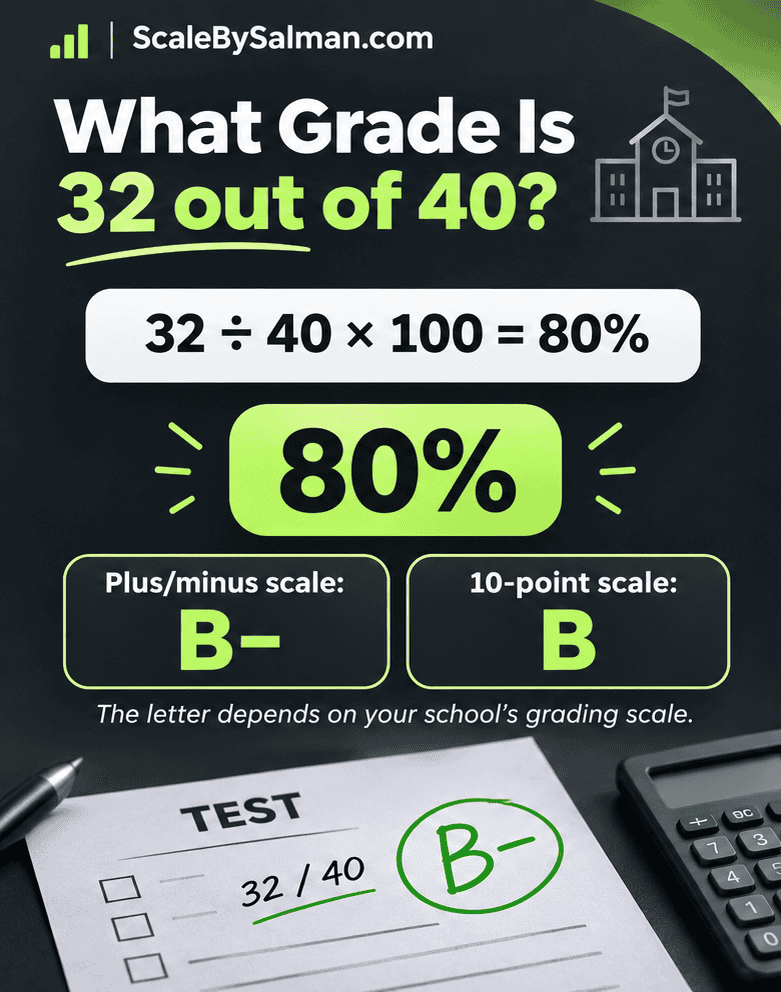
32 out of 40 at a glance: 80%, which is B− or B depending on your school's scale.
Every "what grade is X out of Y" question runs on the same two steps:
Then you match the percentage to a grading scale. That's the part that trips people up, because there isn't one universal scale. Your teacher's syllabus is the final word.
If you'd rather not do the arithmetic, drop your numbers into the Test Grade Calculator. It shows the percentage, the letter grade, and how many more points you'd need for the next grade up.
Below, each line shows a score, its percentage, and the letter grade on two scales. The plus/minus grade follows the common US cutoffs (A+ starts at 97%, A at 93%, A− at 90%, and so on down to D− at 60%). The 10-point grade is the simple version: A is 90 and up, B is 80 to 89, C is 70 to 79, D is 60 to 69, and anything under 60 is an F.
The grade comes from the exact percentage, not a rounded one. So 79.9% is still a C+ on the plus/minus scale, even though it looks like 80.
A quick way to use it: scan the list for your total and score. If your exact numbers aren't listed, the formula above takes ten seconds.
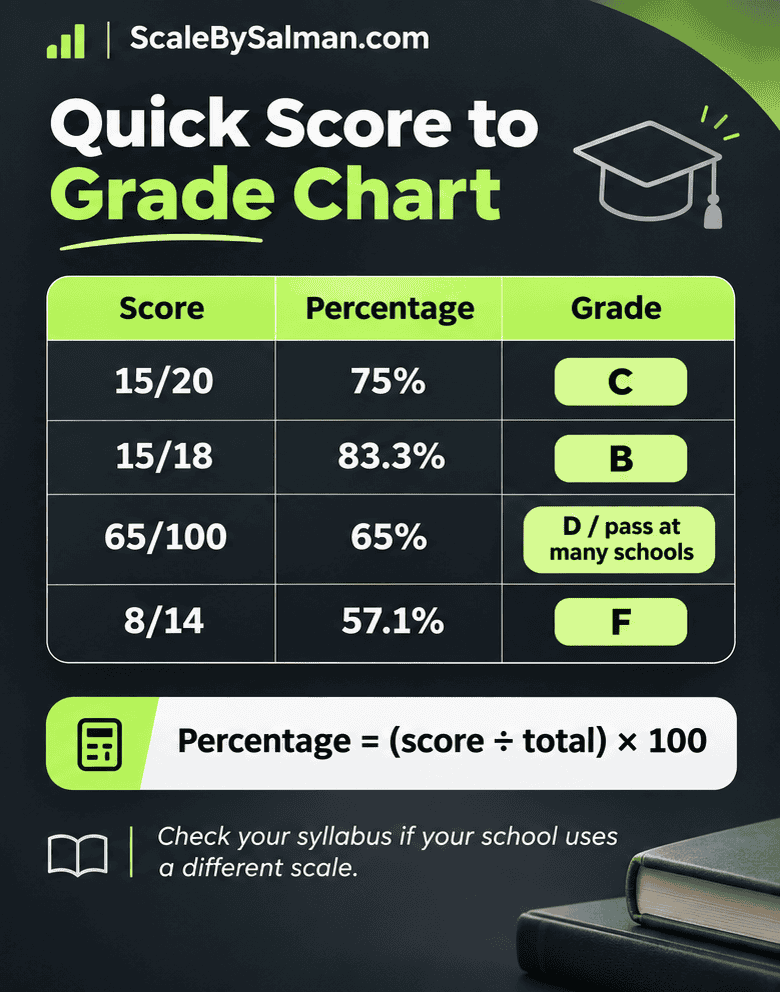
A handy reference for common scores. Check your syllabus if your school uses a different scale.
Running that one example through every common scale shows how much the answer depends on the rulebook:
So what grade is a 32 out of 40? It's 80% every time, and the letter depends on which scale your teacher uses. If you're not sure, ask before you decide whether a score is good or bad.
Look at 32 out of 40 again. It's 80%, and 80% is a B− on one scale and a B on the other. Neither chart is wrong. They answer slightly different questions.
Colleges and high schools set these on their own. Check your syllabus before you panic or celebrate. If you want to see exactly where each cutoff sits, the Test Grade Calculator lets you edit the cutoffs to match your teacher's scale.
Most US schools treat 60% as the lowest passing grade, which is a D− on the plus/minus scale. So 65 out of 100 passes at most schools, and so does 11 out of 15 (73.3%) or 16 out of 20 (80%).
But "passing" isn't the same everywhere. Some courses need a 70% for credit toward a major, many nursing and professional programs set the bar higher, and some schools use a 65% or 70% pass mark for every class. If you're close to the line, read what score you need to pass for how to work out the exact number of points or questions you can afford to miss.
Not every test has 20, 40 or 100 questions. A quiz out of 47 or 14 points still works with the same formula, you just get a decimal.
Two small habits help. First, keep the decimals until the very end and only round the final percentage. Second, if you land right on a boundary like 89.6%, ask your teacher whether they round. Some round to the nearest whole number first, which can bump you up a letter.
Rounding causes more arguments than any other part of grading. There are three common habits: compare the exact percentage to the cutoff, round to the nearest whole number first, or chop off the decimals. A score of 89.6% is a B+ under the first and last habits and an A− under the second. If a score sits within a point of a cutoff, send your teacher a polite question. It takes ten seconds and settles it.
If some questions are worth more than others, don't count questions. Add up the points you earned and divide by the total points possible. A test where you earned 42.5 out of 50 points is 85%, a B on both scales. The Test Grade Calculator has a Points mode for exactly this.
A single test is just one slice of your class grade. If you want to see how this score fits into your overall average, or what you'd need on the final to reach a target, the Final Grade Calculator does the weighting for you. And if you're curious how grades roll up into a GPA, how to calculate GPA walks through it.
A few next steps, depending on what you're trying to work out:
32 out of 40 is 80%. That's a B− on the plus/minus scale (80% to under 83%) and a flat B on the simple 10-point scale. Your syllabus decides which one your teacher uses.
15 out of 20 is 75%. That's a C on the plus/minus scale (73% to under 77%) and a C on the 10-point scale (70% to under 80%). On a 7-point scale, 75% is a D.
15 out of 18 is 83.3%. That's a B on the plus/minus scale and a B on the 10-point scale.
At most US schools, yes. 65% is a D on the plus/minus scale, and 60% is the usual lowest passing mark. Some courses and programs require 70% or more, so check your syllabus.
8 out of 14 is 57.1%. That's an F on both the plus/minus and 10-point scales, and it's about 2.9 percentage points under a typical 60% pass mark.
To turn any score into a grade, divide by the total, multiply by 100, then check the percentage against your teacher's scale. A 32 out of 40 is an 80%, a B− or a B depending on whether your school uses plus and minus. Bookmark the chart above for the common scores, and use the Test Grade Calculator when your numbers are less tidy.
ScaleBySalman has free calculators for test scores, GPA and final exams, and none of them needs an account. Start from the ScaleBySalman homepage, browse the full free tools directory, or read more in the guides library. Questions about your data or our rules? Read the privacy policy and the terms of use, and see our advertising disclosure.
Browse all tools